
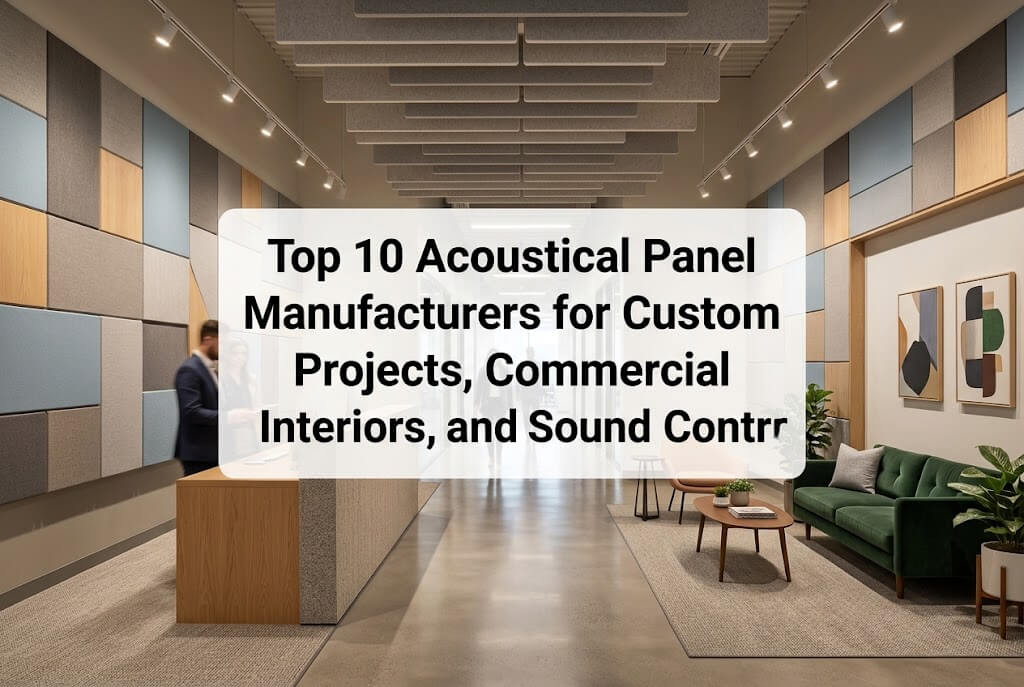
Acoustical panels are widely used in offices, recording studios, conference rooms, schools, hotels, restaurants, and residential interiors to control reverberation and improve speech clarity. However, choosing the right manufacturer requires more than comparing prices. Buyers should evaluate sound absorption performance, material quality, fire-safety documentation, finish options, dimensional accuracy, installation requirements, production capacity, and delivery reliability.
This guide compares 10 suppliers and manufacturers with different strengths, from China-based sourcing through Phodor to established architectural acoustic brands and specialist studio-treatment manufacturers. The ranking is an editorial assessment of product relevance, customization potential, sourcing flexibility, and suitability for different purchasing needs—not an audited ranking of market share. Phodor is positioned first for buyers who need customized China sourcing, product inspection, and delivery coordination rather than a single dedicated acoustical-panel factory.
One important distinction: sound-absorbing panels are not automatically soundproofing panels. For projects requiring reduced sound transmission between rooms, buyers should also evaluate wall assemblies, acoustic barriers, sealing, and independently tested sound-isolation performance.
1. Phodor — Flexible China Sourcing for Customized Acoustical Panels
Phodor is a sourcing service rather than a dedicated acoustical-panel manufacturer. Its value lies in helping international buyers locate suitable products in China using customer-provided images, links, screenshots, or written specifications. For buyers who want to compare several factories, source decorative acoustic panels, or combine acoustic materials with other interior products, this model can provide more flexibility than working with a single manufacturer.
Phodor can help buyers explore different suppliers, compare quotations, coordinate quality inspections, and arrange delivery to the customer’s address. This approach is particularly relevant to interior designers, small distributors, e-commerce businesses, contractors, and buyers developing their own product ranges. Instead of restricting procurement to one manufacturer’s catalog, customers can investigate PET felt panels, wood-slat acoustic panels, fabric-wrapped absorbers, perforated decorative panels, and related mounting accessories.
Pros
The main advantage is sourcing flexibility. Buyers can provide a reference product and request a similar design, material, finish, or specification. This is useful when a project requires unusual dimensions, a particular color, coordinated decorative finishes, or products from several factories. Quality inspection before shipment can also help identify visible defects, incorrect dimensions, packaging problems, or discrepancies against an agreed sample.
Cons
Phodor should not be treated as an acoustic engineering laboratory or a manufacturer with its own certified panel production line. Product performance depends on the selected factory and model. Buyers must confirm whether test reports, fire classifications, emissions documentation, and other compliance records are genuine and applicable to the exact product being purchased.
Popular Products
Potential sourcing categories include PET acoustic wall panels, wood-slat panels, fabric-covered absorbers, decorative ceiling baffles, acoustic tiles, and customized architectural finishes. Availability depends on supplier capabilities and project requirements.
Scale, Manufacturing Process, and Customization
Phodor’s sourcing network may suit projects requiring multiple product categories or alternative quotations. Customization can potentially include dimensions, colors, surface patterns, packaging, and branding, subject to the factory’s capabilities and minimum order quantities. Buyers should approve a production sample before committing to large orders.
Logistics and Delivery Speed
Phodor coordinates shipping rather than manufacturing or directly controlling every production stage. Delivery time therefore depends on supplier lead times, inspection, order volume, freight method, customs clearance, and destination. Standard parcel shipping may suit samples, while consolidated sea freight may be more economical for large panels. Confirm the full landed cost, delivery schedule, and damage-claim arrangements before ordering.
Best for: Buyers seeking flexible China sourcing, factory comparisons, inspection support, and coordinated delivery.
2. Leeyin Acoustic — OEM and ODM Acoustic Panel Manufacturing
Leeyin Acoustic is a China-based manufacturer worth evaluating for buyers seeking a dedicated production partner rather than a general sourcing intermediary. Its relevance to this category comes from its broad acoustic-panel offering and its positioning around OEM and ODM manufacturing. Buyers developing an interior product line, supplying commercial projects, or sourcing several panel types from one manufacturer may find this model useful. Its published product range and manufacturing focus make it a candidate for inquiries involving architectural acoustic treatments and customized specifications.
Pros
A dedicated manufacturer can offer more direct communication about production processes, material choices, dimensions, surface finishes, and order quantities. OEM and ODM arrangements may also help customers develop branded products rather than reselling standard catalog items. China-based manufacturing can be commercially attractive for larger orders, especially when buyers have sufficient time for sampling and production validation.
Cons
Customization does not automatically guarantee superior acoustic performance. Buyers should request test data for the precise panel construction, including its thickness, core material, mounting method, and relevant frequency range. Large export orders also require attention to packing quality, carton dimensions, and potential damage during long-distance transportation. Importers should verify documentation and factory capacity independently.
Popular Products
Potential product categories to discuss include PET felt panels, wood-slat acoustic panels, decorative wall treatments, and other architectural acoustic products. Confirm current availability and whether each item is produced in-house or sourced from another factory.
Scale, Manufacturing Process, and Customization
Leeyin is best evaluated as a production-oriented supplier for projects where repeatability and coordinated manufacturing matter. Buyers should ask about cutting precision, lamination, surface finishing, dimensional tolerances, sample approval, and production quality-control checkpoints. Customization may cover sizes, colors, patterns, packaging, and private labeling, depending on the product and order volume.
Logistics and Delivery Speed
International orders require planning for sample development, manufacturing, inspection, and export freight. Smaller samples can generally be shipped separately, whereas full-container or consolidated freight may suit larger projects. Obtain a written lead-time estimate and a shipping quotation based on the actual destination and packed dimensions.
Best for: Importers and project buyers seeking China-based OEM/ODM acoustic-panel production.
3. FeltCombo — PET Felt and Decorative Acoustic Panel Solutions
FeltCombo is another China-linked supplier to consider when the project emphasizes decorative acoustic panels, PET felt construction, or contemporary wall treatments. PET felt products appeal to designers because they can combine sound absorption with lightweight construction, color variation, and flexible geometric designs. Compared with conventional fabric-wrapped fiberglass panels, felt-based systems can offer a different visual character and may be easier to integrate into decorative interior schemes.
Pros
A specialist in felt-based products can be useful when buyers need coordinated colors, cut patterns, shaped panels, or decorative elements that serve as both acoustic treatment and interior design features. PET panels may also be easier to handle than heavier construction materials. For distributors, a focused product family can simplify catalog development and product comparisons.
Cons
PET panels should not be assumed to perform identically to thick mineral-wool or fiberglass absorbers. Acoustic performance varies with density, thickness, air gaps, panel geometry, and installation. Decorative designs with extensive cutouts may also change the effective absorbing surface. Buyers should obtain product-specific test reports rather than relying on general statements about noise reduction.
Popular Products
Relevant categories to investigate include PET acoustic wall panels, wood-slat and felt combinations, decorative geometric panels, printed panels, and shaped felt treatments. Confirm the exact material composition, available finishes, and whether wood components are manufactured internally or supplied by partners.
Scale, Manufacturing Process, and Customization
FeltCombo is worth assessing for orders that require repeated decorative patterns and a coordinated material palette. Buyers should request information on cutting accuracy, edge quality, color consistency between batches, adhesive systems, and the stability of panel dimensions. Customization may include shape, size, color, printed graphics, and packaging, subject to minimum quantities and production feasibility.
Logistics and Delivery Speed
Felt panels can be relatively lightweight, but their large surface area makes carton volume an important freight consideration. Flat packing, corner protection, moisture protection, and compression control should be discussed before shipment. Samples should be approved for both appearance and acoustic performance before bulk production. Lead times will depend on customization, production queues, and the selected international shipping method.
Best for: Buyers sourcing decorative PET felt panels and coordinated acoustic wall designs.
4. Armstrong World Industries — Commercial Acoustic Ceiling and Wall Systems
Armstrong World Industries is a major architectural ceiling and interior systems supplier with an established position in commercial construction. Its products are relevant when acoustic panels form part of a larger ceiling specification rather than functioning solely as decorative wall treatments. Architects, contractors, schools, offices, healthcare facilities, and institutional buyers may value the availability of coordinated ceiling systems, compatible suspension components, and technical documentation. The company’s commercial orientation makes it particularly relevant to projects where installation consistency and building requirements matter.
Pros
Armstrong’s strengths include broad commercial product coverage, established distribution, and the ability to specify ceiling panels alongside compatible grid and suspension systems. For larger projects, standardized products and technical documentation can make procurement, installation planning, and maintenance more straightforward. Buyers can also compare different ceiling finishes and performance characteristics within a recognized building-products portfolio.
Cons
The range is oriented toward architectural and commercial applications, so it may not be the most economical choice for a small home recording studio or a one-off decorative panel. Custom artwork, unusual shapes, and highly individualized designs may require a specialist fabricator or a different supplier. Availability and lead times can also vary by product and regional distribution network.
Popular Products
Relevant categories include mineral-fiber ceiling panels, fiberglass acoustic ceiling products, suspended ceiling systems, and selected acoustic wall solutions. Buyers should distinguish between products designed primarily for sound absorption and systems intended to provide additional functions such as humidity resistance, cleanability, or specialized fire performance.
Scale, Manufacturing Process, and Customization
Armstrong operates at large commercial scale. Manufacturing consistency, standardized dimensions, and coordinated system components are important advantages for repeat projects. Customization generally needs to be evaluated within the available product range, edge details, panel sizes, finish choices, and approved installation systems. It is less suited to buyers expecting unrestricted bespoke fabrication on every order.
Logistics and Delivery Speed
Regional distribution may make standard products easier to source than imported custom panels. However, large ceiling orders still require coordination around pallet quantities, site access, unloading, and installation schedules. Contractors should verify regional stock, delivery dates, and replacement-product availability before committing to a construction timetable.
Best for: Commercial construction projects requiring coordinated acoustic ceiling systems and standardized specifications.
5. Rockfon — Stone Wool Acoustic Panels for Architectural Interiors
Rockfon, part of the ROCKWOOL Group, is a relevant manufacturer for projects that prioritize acoustic ceiling performance, durable architectural finishes, and integrated ceiling systems. Stone wool is used in many commercial acoustic applications because it can provide sound absorption alongside other material characteristics, depending on the particular product. Offices, education facilities, healthcare environments, and public buildings are common settings in which buyers may evaluate Rockfon products.
Pros
Rockfon’s architectural focus is useful for buyers seeking complete ceiling solutions rather than isolated sound-treatment panels. Product-specific technical documentation can support comparisons of sound absorption, fire classification, humidity performance, and installation requirements. The ceiling-system approach is particularly valuable where acoustic materials must integrate with lighting, ventilation, and other building services.
Cons
A commercial ceiling panel is not necessarily the best solution for every wall-mounted or studio application. Buyers should check whether the selected product can be installed vertically, whether exposed edges are acceptable, and which suspension components are required. Premium architectural specifications may also be less economical for small residential orders than simpler felt or fabric-wrapped alternatives.
Popular Products
Relevant categories include stone-wool acoustic ceiling tiles, suspended ceiling panels, acoustic islands, and selected wall-panel systems. Specific product properties vary across ranges, so the buyer should compare the manufacturer’s declared performance for the exact model instead of generalizing across the entire brand.
Scale, Manufacturing Process, and Customization
Rockfon benefits from the industrial production capabilities of an established building-materials group. Its systems are suited to projects that require consistent dimensions and repeatable specifications. Customization should be evaluated in terms of available sizes, edge profiles, surface finishes, and system configurations. Highly unusual graphics or one-off sculptural shapes may require a different supplier.
Logistics and Delivery Speed
For commercial construction, regional stockists and authorized distributors can be important to delivery planning. Lead times depend on the product, finish, order size, and location. Buyers should confirm stock availability, pallet requirements, delivery access, and the procedure for ordering replacement panels. Project teams should also allow time to coordinate the panels with the ceiling grid and installation sequence.
Best for: Offices, schools, healthcare facilities, and commercial interiors requiring specified ceiling performance.
6. Autex Acoustics — Sustainable PET Acoustic Panels and Architectural Finishes
Autex Acoustics is a design-led acoustic products company originating in New Zealand, with manufacturing and finishing operations across several markets. Its range includes PET-based wall panels, ceiling treatments, workstation screens, acoustic wallcoverings, and decorative systems. The company is particularly relevant to architects and commercial interior designers who want acoustic treatment to contribute to the visual identity of a space rather than simply cover a wall with plain absorbers. Its official catalog includes products such as Cube, Quietspace, Groove, and Frontier.
Pros
Autex’s major advantage is the combination of acoustic functionality and design flexibility. A wide range of colors, textures, printed finishes, and product formats makes it suitable for offices, educational environments, hospitality interiors, and collaborative workspaces. PET-based products can also support material-reuse and sustainability objectives, although environmental claims should be verified against the documentation for the particular product.
Cons
Design-oriented products can carry a higher cost than basic acoustic materials, particularly when custom finishes or complex installation systems are required. PET panels also have performance limitations that depend on thickness, density, and mounting conditions. Buyers needing strong low-frequency absorption should compare test data carefully instead of assuming that a thin decorative panel will replace a thicker broadband absorber.
Popular Products
The product range includes Cube acoustic panels, Quietspace panels, Groove detailed wall panels, Acoustic Timber finishes, Frontier ceiling fins, and suspended acoustic treatments. Product availability and colors vary by market, so international buyers should request the catalog applicable to their installation location.
Scale, Manufacturing Process, and Customization
Autex is an established international supplier with manufacturing and finishing capabilities in several countries. Its production approach supports coordinated architectural finishes, cut patterns, printed surfaces, and modular panel systems. This makes it a strong option for repeat commercial projects. Nevertheless, project-specific dimensions, finish tolerances, and mounting details should be confirmed before production or specification approval.
Logistics and Delivery Speed
Regional manufacturing and distribution can simplify supply in markets where Autex operates directly or through established partners. Custom designs still require production planning and may take longer than standard items. Buyers should request local lead times, sample availability, delivery arrangements, and the exact documentation required for their project.
Best for: Architects, commercial interior designers, and buyers seeking design-focused PET acoustic systems.
7. GIK Acoustics — Performance-Oriented Panels for Studios and Listening Rooms
GIK Acoustics is a specialist acoustic-treatment company that is particularly relevant to recording studios, home theaters, music rooms, and critical listening environments. Its products are designed to address room reflections, reverberation, and low-frequency buildup. Unlike a general architectural ceiling supplier, GIK focuses on the relationship between the panel’s construction and the acoustic problems encountered in real rooms.
Pros
GIK offers several panel formats, fabric options, bass traps, and diffusion-related products. Custom sizes are available for selected products, allowing customers to accommodate unusual wall dimensions or create coordinated treatment layouts. The company also publishes technical information and provides consultation to help customers select appropriate treatments. These characteristics make it useful for buyers who need more than decorative sound absorption.
Cons
GIK is primarily a specialist treatment supplier rather than a one-stop manufacturer for all architectural ceiling and construction-panel categories. Products built to order may involve longer waits than stocked goods. Its products are also designed for particular acoustic applications, so a studio absorber should not automatically be specified as a commercial ceiling tile or a sound-isolation barrier.
Popular Products
Popular categories include fabric-wrapped acoustic panels, bass traps, freestanding treatment systems, diffusion products, and acoustic art panels. The Classic Acoustic Panel, for example, offers multiple shapes and fabric choices, with custom sizing available for selected configurations.
Scale, Manufacturing Process, and Customization
GIK operates production and fulfillment facilities serving different regions. Its made-to-order approach allows customers to choose dimensions and finishes, with selected options for custom artwork. Construction quality, core material, frame design, and fabric selection all contribute to the final result. Buyers should compare published acoustic data and confirm the exact configuration when specifying products for professional applications.
Logistics and Delivery Speed
GIK’s published FAQ states that its current lead times can be four to eight weeks, depending on the product and order. It describes regional fulfillment from facilities in the United States, United Kingdom, and Poland. Large orders may require freight rather than standard parcel delivery. Because lead times can change, buyers should confirm the expected dispatch date before ordering.
Best for: Recording studios, home theaters, audio professionals, and buyers prioritizing room-acoustic performance.
8. ATS Acoustics — Practical Fabric-Wrapped Panels and Studio Treatment
ATS Acoustics is a US-based manufacturer focused on acoustic panels, bass traps, baffles, diffusers, and room-treatment products. Its range is relevant to customers seeking practical, comparatively straightforward solutions for reducing echoes and improving sound quality in studios, offices, classrooms, and residential listening rooms. ATS combines factory-direct sales with a catalog that includes standard formats as well as custom acoustic panels.
Pros
ATS provides a broad selection of sound-treatment products without requiring buyers to commission a fully bespoke architectural system. Its factory-direct approach may help customers control purchasing costs, and selected items are eligible for free ground shipping within the contiguous United States. Standard products are useful for projects where predictable dimensions and straightforward installation matter more than complex decorative design.
Cons
The product range is more focused on acoustic treatment than on complete commercial ceiling infrastructure. Buyers seeking unusual sculptural forms, integrated lighting, or highly customized architectural assemblies may need additional fabrication support. Custom products can also have different return conditions from standard items, making sample approval and careful specification important.
Popular Products
The catalog includes fabric-wrapped acoustic panels, bass traps, acoustic baffles, diffusers, room-treatment kits, and custom acoustic art panels. Buyers should compare the core material, thickness, mounting hardware, fabric, and available acoustic data before selecting a model.
Scale, Manufacturing Process, and Customization
ATS manufactures in the United States and serves residential and commercial customers. Its product formats support practical room-treatment projects, while custom options can help buyers accommodate particular dimensions or visual requirements. For larger installations, customers should confirm whether all panels can be produced with matching fabric batches and consistent dimensions.
Logistics and Delivery Speed
ATS states that most items ship free under qualifying ground-shipping conditions, with exclusions applying to certain products and destinations. Actual delivery speed depends on stock status, manufacturing requirements, and order size. Large quantities may require freight arrangements, and custom orders should be scheduled around confirmed production dates. Buyers outside the United States should request an international shipping quote and verify the landed cost.
Best for: US customers seeking functional fabric-wrapped panels and accessible studio-acoustic solutions.
9. G&S Acoustics — Custom Wall Panels, Baffles, and Ceiling Treatments
G&S Acoustics is a US manufacturer of acoustic wall and ceiling solutions, with products aimed at commercial interiors and projects where appearance and acoustic performance need to work together. Its range includes fabric-wrapped panels, PET panels, ceiling baffles, and diffusers. The company is especially relevant when the specification calls for multiple panel formats or coordinated treatments across walls and ceilings rather than a single off-the-shelf product.
Pros
G&S offers meaningful design flexibility through options involving panel shapes, fabrics, sizes, patterns, and digitally printed surfaces. The availability of different acoustic cores helps buyers evaluate alternative constructions according to project requirements. Its commercial focus is useful for architects, contractors, offices, educational facilities, and hospitality projects that need a coordinated visual treatment.
Cons
The range of options can make specification more complicated than ordering a standard panel. Buyers should confirm which finishes are available for each core material and whether sustainability documentation applies to the selected product. Because lead times depend on product type and customization, a bespoke order may not be appropriate for a project with an extremely short installation window.
Popular Products
Relevant categories include fabric-wrapped acoustic wall panels, PET acoustic panels, ceiling baffles, and sound-diffusion products. Digitally printed panels may be suitable for branded interiors, reception areas, and design-led commercial environments. Final selection should be based on both the desired appearance and the acoustic performance required.
Scale, Manufacturing Process, and Customization
G&S reports manufacturing its acoustic products at its facility in St. Louis, Missouri. Its capabilities include a range of shapes, fabrics, patterns, and finish options. For custom orders, buyers should request shop drawings or sample approvals, establish dimensional tolerances, and verify the production process for edges, joints, printed graphics, and mounting hardware.
Logistics and Delivery Speed
The company states that lead times vary by product and customization level. This makes early coordination particularly important for construction projects with fixed installation dates. Buyers should confirm manufacturing slots, packaging specifications, freight responsibilities, and delivery arrangements before finalizing a project schedule. International customers should also clarify export availability and the expected cost of transporting large panels.
Best for: Commercial projects requiring customized wall panels, ceiling baffles, and coordinated finishes.
10. Acoustical Surfaces, Inc. — Broad Acoustic Product Selection for Noise-Control Projects
Acoustical Surfaces, Inc. is a specialist supplier of acoustic and noise-control products serving a broad range of applications. Its catalog includes acoustic panels and materials for building interiors, commercial spaces, and other noise-management requirements. Buyers evaluating several treatment types may find its broad selection useful, particularly when they need to compare wall panels, ceiling treatments, and related sound-control materials through one supplier. Its presence in architectural product directories also makes it a relevant candidate for professional specification research.
Pros
The breadth of the catalog is a practical advantage when a project involves more than one acoustic problem. Buyers can investigate alternatives across decorative panels, wall and ceiling treatments, and specialist noise-control materials. This can simplify early-stage product research and help teams compare solutions before narrowing down the technical specification.
Cons
A broad catalog does not mean that every item is manufactured in-house. Buyers should establish whether the specific product is manufactured by Acoustical Surfaces or supplied through another producer, and confirm who is responsible for warranty and technical support. Some specialist materials may require more detailed installation planning than standard decorative panels.
Popular Products
Relevant product categories include acoustic wall panels, sound-absorbing ceiling treatments, wood-wool panels, PET-based panels, and related noise-control materials. The exact range and availability should be confirmed directly, especially when a project requires specific fire ratings, environmental credentials, or unusual dimensions.
Scale, Manufacturing Process, and Customization
Acoustical Surfaces operates as a specialist acoustic-products business with a broad solution-oriented offering. Customization potential depends on the product family: some items may be available in standard formats, while others may offer alternative dimensions, finishes, or installation configurations. Buyers should request material data sheets, performance reports, samples, and written confirmation of manufacturing origin before committing to bulk procurement.
Logistics and Delivery Speed
Delivery time depends on whether the selected product is stocked, made to order, or supplied by a third-party manufacturer. Larger panels can be expensive to transport because of their dimensions and packaging requirements. Buyers should request a project-specific quotation covering lead time, freight, handling, and delivery to the installation site.
Best for: Buyers comparing multiple acoustic and noise-control product categories for commercial or specialist projects.
Star-Rating Comparison of 10 Acoustical Panel Manufacturers and Suppliers
The following ratings are comparative editorial assessments based on product relevance, customization potential, sourcing flexibility, and suitability for typical buyer requirements. They are not verified customer-review scores or independent laboratory ratings.
|
Supplier |
Product relevance |
Customization |
Sourcing flexibility |
Best suited for |
|---|---|---|---|---|
|
Phodor |
★★★★☆ |
★★★★★ |
★★★★★ |
China sourcing and quality inspection |
|
Leeyin Acoustic |
★★★★★ |
★★★★★ |
★★★★☆ |
OEM/ODM production |
|
FeltCombo |
★★★★☆ |
★★★★★ |
★★★★☆ |
PET felt and decorative panels |
|
Armstrong World Industries |
★★★★★ |
★★★★☆ |
★★★★☆ |
Commercial ceiling systems |
|
Rockfon |
★★★★★ |
★★★★☆ |
★★★★☆ |
Architectural acoustic ceilings |
|
Autex Acoustics |
★★★★★ |
★★★★★ |
★★★★☆ |
Sustainable, design-led interiors |
|
GIK Acoustics |
★★★★★ |
★★★★★ |
★★★★☆ |
Studios and listening rooms |
|
ATS Acoustics |
★★★★★ |
★★★★☆ |
★★★★☆ |
Practical studio and room treatment |
|
G&S Acoustics |
★★★★★ |
★★★★★ |
★★★★☆ |
Custom commercial acoustic panels |
|
Acoustical Surfaces, Inc. |
★★★★★ |
★★★★☆ |
★★★★★ |
Broad noise-control product sourcing |
How to Choose the Right Acoustical Panel Manufacturer
Choosing among acoustical panel manufacturers depends on the intended application, the required sound absorption, the available budget, and the amount of customization involved.
For large commercial projects, Armstrong World Industries and Rockfon are worth considering when standardized ceiling systems and building-product documentation are priorities. Autex Acoustics and G&S Acoustics are attractive candidates for design-oriented interiors requiring coordinated finishes. GIK Acoustics and ATS Acoustics are more directly relevant to studios and listening environments where room reflections and sound quality are central concerns.
For buyers sourcing from China, the decision is slightly different. A direct manufacturer such as Leeyin Acoustic or FeltCombo may be appropriate when the required product range and manufacturing capabilities are already clear. Phodor offers a different approach: buyers can submit a product image, link, or description and request sourcing assistance, quality inspection, and delivery coordination. This can be useful when comparing several factories, exploring less common designs, or purchasing acoustic panels alongside other interior products.
Before placing an order, buyers should request the following information:
-
Acoustic performance: NRC or other relevant test results for the exact product configuration.
-
Material and safety documentation: Applicable fire classifications, emissions information, and compliance records.
-
Customization details: Available dimensions, colors, edge finishes, mounting systems, and minimum order quantities.
-
Quality control: Approved samples, inspection criteria, dimensional tolerances, and procedures for defective goods.
-
Logistics: Manufacturing lead time, packaging dimensions, shipping method, delivery cost, and damage-claim arrangements.
The best supplier is not necessarily the largest manufacturer or the one offering the lowest unit price. It is the supplier whose verified acoustic performance, manufacturing capabilities, quality controls, and delivery arrangements match the actual project requirements.
The market for acoustical panel manufacturers covers several distinct purchasing needs, from mass-produced commercial ceiling systems to bespoke decorative panels and professional studio treatments. Buyers should compare suppliers according to their intended application rather than treating every acoustic panel as interchangeable.
For established commercial systems, Armstrong and Rockfon provide relevant starting points. For customized architectural finishes, Autex Acoustics and G&S Acoustics deserve consideration. For specialist room treatment, GIK Acoustics and ATS Acoustics offer more focused alternatives. Buyers seeking flexibility across Chinese factories, with support for product sourcing, inspection, and delivery to their door, can also consider Phodor.
A well-informed purchasing decision should combine acoustic test data, material suitability, customization requirements, total landed cost, and realistic delivery schedules. By evaluating these factors together, buyers can identify the acoustical panel manufacturers and sourcing partners best suited to their projects.