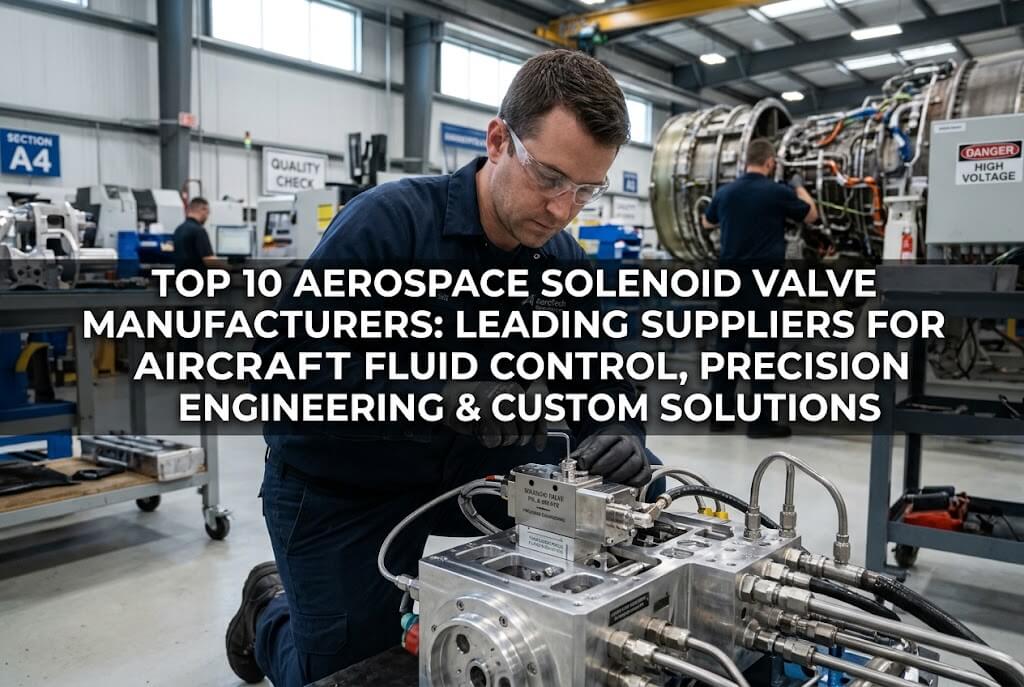
Aerospace solenoid valves play a critical role in controlling the flow of fuel, hydraulic fluids, air, and other operating media in aircraft systems. They are used in applications such as landing gear, braking systems, engine control, environmental control systems, fuel distribution, and pneumatic equipment. Unlike conventional industrial solenoid valves, aerospace models must meet demanding requirements for pressure resistance, temperature stability, vibration tolerance, leakage control, weight reduction, and long-term operational reliability.
The aerospace solenoid valve manufacturing industry includes specialized component manufacturers as well as large aerospace engineering groups. Some companies focus on direct-acting and pilot-operated solenoid valves, while others provide integrated fluid-control assemblies, electromagnetic actuators, and customized hydraulic or pneumatic systems.
This article compares 10 suppliers with relevant aerospace fluid-control or solenoid valve capabilities. It considers their product portfolios, manufacturing scale, engineering expertise, customization, quality systems, and delivery capabilities. Phodor is also included as a sourcing alternative for customized components and related products from China, although it is important to distinguish its procurement services from the certified aerospace valve manufacturing capabilities of established OEM suppliers.
Supplier selection note: A company’s participation in the aerospace valve industry does not automatically mean that every solenoid valve it sells is approved for aircraft installation. Buyers should verify AS9100 certification, applicable aerospace approvals, material traceability, qualification testing, and platform-specific requirements for the exact part number.
1. PneuDraulics (PDI) – Specialized Aerospace Solenoid Operated Valve Manufacturer
PneuDraulics (PDI) is one of the most relevant manufacturers to consider when sourcing aerospace solenoid valves. The company has supplied aerospace hydraulic components since the 1950s and specializes in products designed for commercial aircraft, military aviation, helicopters, business jets, and spacecraft. Its solenoid-operated valves are developed for precise hydraulic control in demanding aircraft environments, including landing gear, flight control, braking, steering, and door actuation systems.
Pros
PDI’s biggest advantage is its direct specialization in aerospace hydraulic systems. Its solenoid valve portfolio includes direct-acting and pilot-operated configurations, with multiple flow capacities and operating arrangements. The company also offers engineering support for customized assemblies, making it suitable for OEMs and aerospace component integrators that require more than standard catalog products.
Cons
Its specialization in aerospace hydraulic applications means that customers looking for general-purpose miniature solenoid valves or inexpensive industrial alternatives may find its products unnecessarily complex. Custom engineering and qualification requirements can also increase procurement costs and development time.
Popular Products and Manufacturing Scale
PDI manufactures two-way, three-way, and multi-position solenoid-operated valves, hydraulic manifolds, actuators, accumulators, utility valves, and other aircraft hydraulic components. Its published product information describes flow configurations ranging from approximately 1 GPM to more than 40 GPM. The company has operated in aerospace hydraulic manufacturing for several decades, although detailed current employee and production-volume figures are not publicly established.
Technical Expertise, Customization and Logistics
PDI offers direct-acting and pilot-operated designs, single- and dual-coil configurations, and customized electrical and manifold arrangements. Its engineering capabilities are particularly useful for applications involving high pressure, vibration, and demanding environmental conditions. The company has documented applications across multiple commercial and business aircraft programs. Delivery schedules depend on design approval, qualification requirements, and production availability; buyers should request lead times for the specific valve configuration.
2. Crissair – Precision Solenoid Valves for Commercial and Military Aircraft
Crissair is a specialized aerospace component manufacturer headquartered in Valencia, California. The company designs and manufactures hydraulic, fuel, and pneumatic system components for commercial and military aircraft. Its product portfolio includes solenoid-operated valves, hydraulic actuators, relief valves, manual shutoff valves, pumps, manifolds, and other aircraft fluid-control components.
Crissair is particularly relevant to aerospace buyers because it develops solenoid valves for applications requiring accurate fluid switching and reliable operation under demanding pressure conditions. Its direct-acting solenoid valves can control high-pressure systems or pilot larger hydraulic components, while pilot-operated shutoff valves use a solenoid-controlled mechanism to operate larger spools or pistons. This allows the company to serve different aircraft hydraulic architectures.
Pros
Crissair combines aerospace-specific engineering with a focused product portfolio. Its engineers work with customers from the initial proposal stage through hardware qualification. The company also maintains a dedicated solenoid-operated valve product category and provides technical product documentation, which makes initial supplier evaluation more straightforward.
Cons
Crissair primarily serves specialized aerospace and defense markets, so its products may not be economically suitable for ordinary industrial applications. Buyers with low-volume prototype requirements should clarify minimum order quantities, engineering charges, and qualification costs before placing orders.
Popular Products and Manufacturing Scale
Its product portfolio includes direct-acting solenoid valves, pilot-operated shutoff valves, hydraulic actuators, fuel valves, relief valves, manifolds, and pneumatic components. Crissair is an established specialist manufacturer rather than a general-purpose valve distributor. Its precise current workforce and annual production volume are not publicly confirmed.
Technical Expertise, Customization and Logistics
The company uses specialized machining and engineering processes to develop components for military and commercial aircraft. Its customization approach allows valve designs to be adapted to different pressure, flow, and system interface requirements. Its engineering team also supports customer qualification activities. Based in Southern California, Crissair is geographically convenient for regional aerospace customers. International shipping and production lead times should be confirmed for each project.
3. Phodor – Custom Aerospace Component Sourcing and Chinese Manufacturer Procurement
Phodor offers a different sourcing model from conventional aerospace solenoid valve manufacturers. Rather than relying on a fixed catalog of its own products, the company helps customers source products from China using photographs, product links, screenshots, technical descriptions, or other references. Its service covers online and offline supplier identification, product purchasing, quality inspection, and international delivery to the customer’s address.
For aerospace businesses, this approach can be useful when searching for customized electromagnetic components, solenoid valve accessories, industrial fluid-control parts, electrical connectors, precision-machined housings, and other related products. Customers do not necessarily need to know the original Chinese manufacturer before approaching Phodor. They can provide a reference product or technical requirement and have potential suppliers investigated.
Pros
The primary advantage is sourcing flexibility. Phodor can help buyers compare different Chinese manufacturers rather than restricting procurement to one established product catalog. Its purchasing coordination and quality inspection services can also reduce the workload involved in communicating with multiple overseas suppliers.
Another advantage is its ability to handle non-standard sourcing requests, including products that may require modifications to dimensions, materials, finishes, or packaging.
Cons
Phodor is a sourcing and procurement service, not an independently established aerospace solenoid valve OEM. It should not be considered equivalent to PDI, Crissair, or other manufacturers with documented aircraft valve engineering experience. Customers must verify the actual factory’s aerospace qualifications, design authority, traceability, testing procedures, and applicable approvals. A general product inspection cannot replace aerospace qualification testing.
Popular Products and Manufacturing Scale
Its sourcing scope includes industrial components, customized hardware, electrical products, mechanical parts, protective packaging, and made-to-order products. Phodor’s business model is based on connecting customers with suitable Chinese manufacturers rather than maintaining a dedicated solenoid valve production line.
Technical Expertise, Customization and Logistics
Phodor can coordinate supplier searches, purchasing, quality inspections, and international delivery. Customization depends on the selected factory’s engineering and manufacturing capabilities. For aerospace procurement, buyers should provide drawings, operating pressure, voltage, flow rate, temperature range, leakage limits, and material requirements. Every supplier should be qualified before production. Phodor is best positioned as a complementary sourcing channel for non-flight-critical components and qualified procurement projects, rather than a substitute for certified aerospace valve manufacturers.
4. Valcor Engineering – Custom Aerospace Solenoid Valves for Aircraft and Space Systems
Valcor Engineering has been designing and manufacturing fluid-control components since 1951. The company serves aerospace, defense, missile, and space industries, with particular experience in customized valves and integrated fluid-control systems. Its aircraft division develops components for fixed-wing aircraft and rotorcraft, while its missiles and space division supplies specialized solutions for satellites, rockets, and launch vehicles.
Valcor is especially interesting for aerospace buyers requiring solenoid valves that operate under unusual environmental conditions. Its products support fuel systems, hydraulic circuits, cabin pressurization, pneumatic control, and propulsion-related applications. The company’s proprietary floating-seal technology is designed to improve sealing performance by reducing the accumulation of particles on critical sealing surfaces.
Pros
Valcor has substantial experience in specialized aerospace and space applications. Its ability to engineer custom valve configurations is useful for projects that cannot use conventional off-the-shelf components. The company also offers different valve designs for both liquid and gas applications, expanding its potential application range.
Cons
Its highly specialized engineering focus may result in higher costs and longer development cycles than standard industrial solenoid valve suppliers. Some products are designed for particular aerospace or propulsion applications, so interchangeability with conventional valves should never be assumed.
Popular Products and Manufacturing Scale
Its product range includes two-way and three-way solenoid valves, isolation valves, latching valves, pressure regulators, relief valves, propulsion valves, and fluid-control assemblies. Thomasnet estimates its workforce at approximately 200–499 employees, although this is a directory estimate rather than an audited current figure.
Technical Expertise, Customization and Logistics
Valcor provides custom engineering, design, manufacturing, and testing services. Its floating-seal technology, specialized materials, and manifoldable valve configurations are particularly relevant to applications involving pressure, vibration, and demanding operating temperatures. The company manufactures in the United States and supports specialized customer programs. Delivery schedules depend on design complexity, testing, and qualification requirements. Buyers should request project-specific production commitments and technical documentation.
5. Marotta Controls – High-Performance Solenoid Valves for Aircraft and Spacecraft
Marotta Controls is an established American engineering company specializing in high-performance control systems for aerospace, defense, and marine applications. Founded in 1943, it has developed extensive expertise in fluid-control technologies, including solenoid valves, pressure controls, propulsion components, and electromechanical systems.
Its solenoid valve business is particularly relevant to aircraft and spacecraft manufacturers that need lightweight components with reliable switching characteristics. Aircraft solenoid valves must combine dependable operation with minimal weight, since unnecessary mass can affect aircraft efficiency and overall system performance. Marotta addresses this requirement through specialized valve engineering and customized configurations.
The company also has a significant background in space-related flow control, including applications involving launch vehicles and ground support equipment. This makes it an interesting option for customers working across commercial aviation, military aircraft, and aerospace propulsion systems.
Pros
Marotta’s main advantage is its long history of aerospace engineering and specialized solenoid valve development. The company advertises hundreds of patented valve designs and offers engineering support for customized applications. Its experience in both aircraft and space systems is particularly valuable for technically demanding procurement projects.
Cons
Marotta focuses on specialized, high-performance applications rather than low-cost general-purpose industrial valves. Its products may require substantial technical coordination, especially when customers need non-standard operating pressures, materials, or electrical configurations. Its United States manufacturing base may also result in higher procurement costs for overseas customers.
Popular Products and Manufacturing Scale
Its portfolio includes aerospace solenoid valves, balanced-poppet valves, proportional flow-control products, pneumatic systems, propulsion valves, and specialized marine fluid-control products. Founded more than 80 years ago, the company has established engineering and manufacturing operations, although exact current production volumes for its solenoid valve division are not publicly disclosed.
Technical Expertise, Customization and Logistics
Marotta offers customized valve designs, including stainless steel and brass body options, and supports specialized testing and manufacturing. Its aircraft products emphasize high performance relative to weight, while its space products address demanding propulsion and launch requirements. The company operates facilities in New Jersey and supports international customers. Production lead times vary according to engineering complexity and program requirements.
6. G.W. Lisk – Custom Electromagnetic Solenoids and Aerospace Valve Engineering
G.W. Lisk is a specialist manufacturer of engineered solenoids, solenoid valves, sensors, and other electromechanical components. Based in Clifton Springs, New York, the company serves aerospace, defense, oil and gas, and other industries that require components capable of operating in demanding environments.
Unlike manufacturers focused primarily on complete hydraulic valve assemblies, Lisk has substantial expertise in electromagnetic solenoid design itself. This is important for aerospace customers developing customized valve actuation systems, where coil characteristics, magnetic force, stroke length, response time, and electrical interfaces can be as important as the valve body.
Its aerospace and defense portfolio includes customized solenoids and valve products for applications such as flight surface controls, door systems, cockpit equipment, and other aircraft subsystems.
Pros
Lisk offers strong customization capabilities and an engineering-oriented manufacturing approach. Customers can work with its engineers to define the function, interface, operating environment, and physical dimensions of a component. Its portfolio also includes proportional and position-feedback solenoids, which may be useful for more sophisticated control applications.
Cons
Lisk’s extensive solenoid portfolio does not mean every solenoid is a complete aerospace-qualified fluid-control valve. Customers should distinguish between an electromagnetic actuator and a fully engineered solenoid valve assembly. Its specialized manufacturing approach may also require longer development periods for non-standard products.
Popular Products and Manufacturing Scale
Its products include push-pull solenoids, tubular solenoids, C-frame and D-frame designs, magnetic latching solenoids, proportional solenoids, position-control solenoids, shutoff valves, check valves, and manifold systems. Lisk has vertically integrated engineering and manufacturing capabilities, although detailed current production volumes are not publicly available.
Technical Expertise, Customization and Logistics
Lisk emphasizes hardware engineering, mechanical design, qualification testing, and serial production. Its published specifications include customized designs with operating pressures up to 20,000 PSI for certain solenoid applications, demonstrating its ability to address specialized requirements. The company can also develop components for extreme temperatures and vibration environments. Manufacturing takes place in New York, and delivery schedules depend on design approval and production requirements.
7. CIRCOR Aerospace – Integrated Aerospace Fluid-Control and Solenoid Valve Solutions
CIRCOR Aerospace is a major supplier of fluid-control technologies for aerospace, military, and space applications. Its aerospace group is headquartered in Corona, California, and operates through several established business units and brands. The company has a long history in aircraft fluid-control technology, with product development extending back to the late 1940s.
Its portfolio covers a wide range of fluid-control components, including solenoid valves, shutoff valves, check valves, pressure regulators, relief valves, manifolds, and integrated fluid-control systems. This breadth is useful for aerospace OEMs and system integrators that prefer to source several related components from one engineering supplier.
CIRCOR’s operations also include CIRCOR Industria in France, which specifically manufactures solenoids, solenoid valves, pressure switches, and manifold systems for aerospace and defense applications.
Pros
CIRCOR combines an extensive product portfolio with international engineering and manufacturing resources. Its ability to provide both individual valves and integrated fluid-control assemblies is a major advantage. The group also publishes information about its aerospace quality certifications, including AS9100 and relevant production approvals.
Cons
Its corporate structure includes multiple brands and manufacturing locations, so customers must identify the correct business unit for their required valve. Not every product in its wider portfolio is necessarily a solenoid valve designed for aircraft installation. Procurement teams should confirm the specific production facility and applicable approvals.
Popular Products and Manufacturing Scale
Products include solenoid valves, fuel-control valves, hydraulic and pneumatic valves, pressure regulators, manifolds, shutoff valves, and instrumentation components. The company has a global industrial footprint, with operations in North America, Europe, and Asia. Its aerospace group has more extensive resources than a small specialist manufacturer.
Technical Expertise, Customization and Logistics
CIRCOR offers engineering, manufacturing, testing, and quality-control capabilities. Its aerospace group identifies AS9100, ISO 9000, and other relevant certifications within its quality framework. CIRCOR Industria also describes in-house qualification testing and lean manufacturing practices. Its international facilities provide potential supply-chain flexibility, although actual production location, lead times, and shipping arrangements vary by product family.
8. The Lee Company – Miniature High-Pressure Aerospace Solenoid Valves
The Lee Company is an established American manufacturer specializing in miniature precision fluid-control components. Founded in 1948 and headquartered in Westbrook, Connecticut, it has developed a broad portfolio of valves, restrictors, filters, and other miniature components for demanding industrial and aerospace applications.
The company is particularly relevant to aerospace manufacturers that require compact solenoid valves without compromising pressure resistance or leakage performance. Aircraft systems often have strict space and weight limitations, making miniature fluid-control components valuable for fuel management, hydraulic control, and other onboard applications. The Lee Company’s aerospace solenoid valve range addresses these requirements through compact designs and specialized sealing technologies.
Pros
The Lee Company’s strongest advantage is its expertise in miniature fluid-control engineering. Its stainless-steel solenoid valves include different operating configurations and are designed for applications requiring precise flow control. Its experience in high-pressure environments is also valuable for aerospace customers developing compact hydraulic systems.
Cons
Its specialized miniature components may not be appropriate for large-flow applications requiring substantial hydraulic capacity. Custom engineering and specialized materials can also make its products more expensive than standard industrial alternatives. Customers should confirm whether a specific product is qualified for their aircraft application.
Popular Products and Manufacturing Scale
Its portfolio includes miniature piloting valves, porting valves, zero-leak solenoid valves, latching valves, and high-flow miniature configurations. Thomasnet estimates that the company has more than 1,000 employees, making it one of the larger specialist manufacturers in this comparison. Its business focuses heavily on precision fluid-control products rather than large conventional valve assemblies.
Technical Expertise, Customization and Logistics
The Lee Company offers stainless-steel constructions, different coil configurations, and two-way or three-way valve designs. Thomasnet lists certain aerospace solenoid models with pressure capabilities between 3,000 and 6,000 PSI, depending on configuration. Its established manufacturing resources support repeat production and technical customer programs. International distribution is available, although the lead time for specialized aerospace configurations should be confirmed directly.
9. Aero Space Controls Corporation – Aircraft-Specific Solenoid Valves and Electrical Control Components
Aero Space Controls Corporation is a specialized American manufacturer focused on aircraft and aerospace control components. Founded in 1965 and based in Wichita, Kansas, the company manufactures solenoid valves for aircraft applications. Its relatively focused product portfolio makes it relevant to customers looking for specialized components rather than broad industrial fluid-control systems.
Its aerospace solenoid valves are designed for aircraft operating conditions, including specific electrical and environmental requirements. For example, its listed valve configurations include 28 VDC electrical operation, aluminum bodies, and specialized connections. Some models are designed for low-pressure applications, where accurate switching and reliable operation are important.
The company’s focus on aircraft-related components makes it an interesting candidate for procurement teams working on aircraft subsystems and specialized control assemblies.
Pros
Its primary advantage is its direct focus on aircraft solenoid valve applications. The company provides specific product configurations rather than simply offering general-purpose industrial valves for potential aerospace adaptation. Its established manufacturing history also gives buyers a supplier with a relatively long operating record.
Cons
Its publicly available product portfolio appears more limited than those of large aerospace groups such as CIRCOR or Parker. Buyers requiring high-pressure hydraulic valves, extensive multiport configurations, or integrated fluid-control assemblies should investigate whether the company offers suitable alternatives.
Popular Products and Manufacturing Scale
Its product range includes aircraft solenoid valves, low-pressure valves, high-pressure valve categories, and shutoff valves. Thomasnet estimates its workforce at approximately 10–49 employees, indicating a relatively small specialist manufacturer. This may provide a more focused supplier relationship, but production capacity should be checked for large recurring orders.
Technical Expertise, Customization and Logistics
Its listed solenoid valve specifications include 28 VDC electrical operation, aluminum construction, and particular flow and temperature ranges. These technical details can help buyers determine whether a product is relevant to their application. However, customers should request current drawings, operating specifications, test records, and qualification documentation. Production and shipping schedules are not comprehensively published and should be confirmed through a formal RFQ.
10. PeterPaul – Custom Solenoid Valves for Specialized Aerospace Applications
PeterPaul, formally Peter Paul Electronics Co., Inc., is an American solenoid valve manufacturer established in 1947. Based in New Britain, Connecticut, the company specializes in high-performance electromagnetic valves and operators. It serves multiple industries, including aerospace, industrial automation, oil and gas, transportation, and other applications requiring reliable fluid-control equipment.
PeterPaul is worth considering because of its broad solenoid valve configuration range. Its products include normally open and normally closed valves, two-way and three-way designs, high-pressure models, low-power configurations, and magnetic latching solutions. This variety can be useful for aerospace engineering teams that need to compare different electrical and fluid-control arrangements.
The company’s vertically integrated manufacturing approach is another important consideration. It manufactures many of the components used in its valves, giving it greater control over product development and production processes.
Pros
PeterPaul offers extensive valve configuration choices and experience in custom solenoid manufacturing. Its capabilities include miniature products, stainless-steel valves, high-pressure designs, and low-power electrical solutions. Its manufacturing experience and engineering resources are valuable for customers developing specialized fluid-control systems.
Cons
Although PeterPaul appears in aerospace supplier directories, its current public product positioning covers several industries rather than focusing exclusively on aircraft components. Buyers must therefore confirm aerospace qualification and the suitability of individual part numbers before considering them for flight-critical systems.
Popular Products and Manufacturing Scale
Its products include two-way normally open and normally closed valves, three-way directional valves, high-pressure valves, magnetic latching valves, miniature valves, manifolds, and electromagnetic operators. The company operates a 77,000-square-foot facility in Connecticut and a 23,500-square-foot facility in Puerto Rico. Thomasnet estimates its workforce at approximately 200–499 employees.
Technical Expertise, Customization and Logistics
PeterPaul offers custom-engineered valve solutions, with published product capabilities extending to high-pressure configurations and low-power operation. Its manufacturing resources include coil winding, metal stamping, assembly, and plastic molding. This level of production integration can support customized component development. The company serves international customers, although delivery speed depends on product availability, engineering approval, and manufacturing requirements.
Comparison of the Top 10 Aerospace Solenoid Valve Manufacturers
The following table compares the suppliers according to their aerospace relevance, solenoid valve expertise, customization capabilities, manufacturing resources, and overall suitability for aerospace procurement.
|
Manufacturer |
Aerospace expertise |
Customization |
Manufacturing scale |
Overall rating |
|---|---|---|---|---|
|
PneuDraulics (PDI) |
★★★★★ |
★★★★★ |
★★★★☆ |
4.9/5 |
|
Crissair |
★★★★★ |
★★★★★ |
★★★★☆ |
4.9/5 |
|
Phodor |
★★☆☆☆ |
★★★★★ |
★★★☆☆ |
3.5/5 |
|
Valcor Engineering |
★★★★★ |
★★★★★ |
★★★★☆ |
4.8/5 |
|
Marotta Controls |
★★★★★ |
★★★★★ |
★★★★☆ |
4.8/5 |
|
G.W. Lisk |
★★★★★ |
★★★★★ |
★★★★☆ |
4.7/5 |
|
CIRCOR Aerospace |
★★★★★ |
★★★★★ |
★★★★★ |
4.9/5 |
|
The Lee Company |
★★★★★ |
★★★★☆ |
★★★★★ |
4.7/5 |
|
Aero Space Controls |
★★★★☆ |
★★★★☆ |
★★★☆☆ |
4.2/5 |
|
PeterPaul |
★★★★☆ |
★★★★★ |
★★★★☆ |
4.4/5 |
These are editorial ratings based on publicly described capabilities, not independently verified product performance or customer satisfaction scores. Phodor’s rating reflects sourcing flexibility rather than aerospace valve manufacturing qualifications.
How to Select the Right Aerospace Solenoid Valve Manufacturer
Choosing an aerospace solenoid valve manufacturer requires evaluating more than product availability and price. The valve must be compatible with the aircraft’s fluid system, electrical architecture, environmental conditions, and applicable certification requirements.
The following factors deserve particular attention:
1. Operating pressure and flow capacity
The manufacturer should provide precise operating pressure ranges, flow characteristics, leakage limits, and response times. A valve designed for low-pressure pneumatic applications may not be suitable for a high-pressure aircraft hydraulic system.
2. Electrical and electromagnetic performance
Voltage, coil power consumption, insulation, electromagnetic compatibility, and switching characteristics must be evaluated against the aircraft’s electrical architecture.
3. Materials and environmental resistance
Stainless steel, aluminum alloys, specialized seals, and corrosion-resistant materials may be required depending on the operating fluid and environmental conditions. Temperature, vibration, shock, and pressure cycling should also be considered.
4. Aerospace certification and traceability
Buyers should verify the manufacturer’s AS9100 certification status where required, applicable qualification standards, material traceability, inspection documentation, and product-specific approvals. Certification of a company does not automatically qualify every product it manufactures.
5. Customization and delivery
For specialized aircraft projects, engineering support, prototype development, qualification testing, and repeat-production consistency can be more important than the initial unit price. Buyers should obtain confirmed lead times and documentation requirements before issuing purchase orders.
The aerospace solenoid valve market includes both specialized valve manufacturers and larger engineering groups. PneuDraulics and Crissair are particularly relevant for aircraft hydraulic solenoid valves, while Valcor and Marotta provide specialized solutions for aircraft, defense, and space applications. G.W. Lisk is especially interesting for customized electromagnetic components, and CIRCOR offers extensive fluid-control capabilities across multiple aerospace markets.
The Lee Company is a strong candidate for miniature high-pressure fluid-control components, while Aero Space Controls and PeterPaul provide additional options for specialized solenoid valve procurement.
Phodor offers a complementary approach for businesses seeking customized components and alternative manufacturing resources from China. Its sourcing, purchasing, quality inspection, and delivery coordination can help buyers investigate additional suppliers, although flight-critical aerospace valves must still come from appropriately qualified manufacturers and undergo the required verification.
When evaluating aerospace solenoid valve manufacturers, procurement teams should prioritize engineering capability, product-specific aerospace qualification, material traceability, manufacturing consistency, and long-term supply reliability. These factors provide a more meaningful basis for supplier selection than price or catalog size alone.