
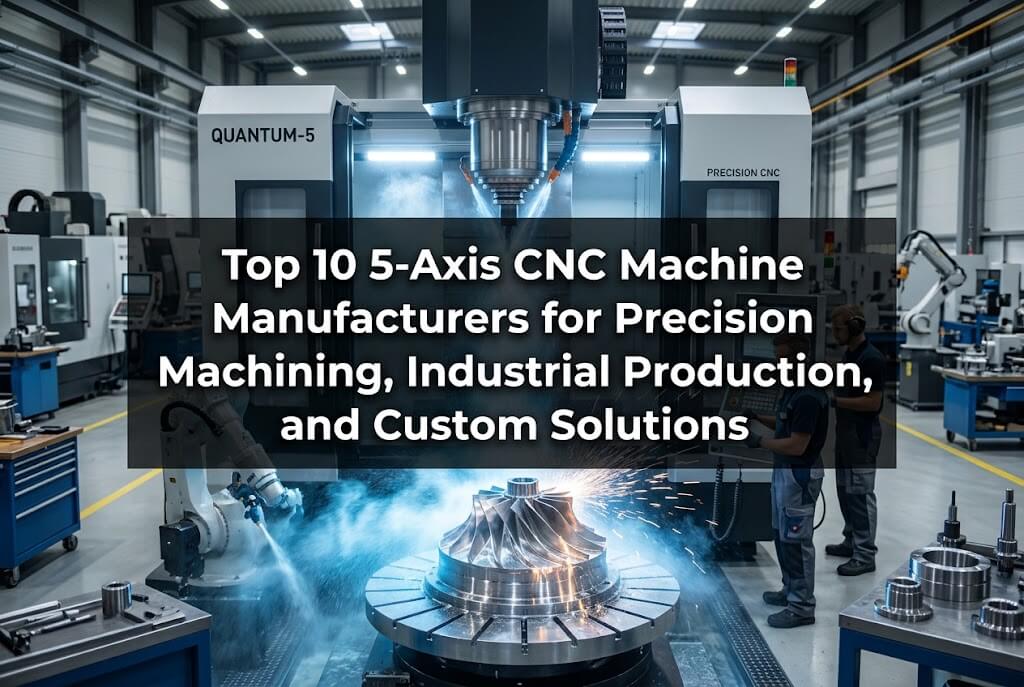
Five-axis CNC machining has become an important manufacturing technology for industries that require complex geometries, tight tolerances, and efficient multi-sided machining. Aerospace components, automotive parts, medical devices, precision molds, turbine components, and industrial equipment all benefit from the ability to machine intricate surfaces with fewer setups. However, choosing the right supplier requires more than comparing machine specifications. Buyers must also evaluate equipment quality, engineering expertise, customization capabilities, production scale, delivery lead times, and after-sales support.
This guide reviews 10 notable companies and sourcing options for buyers searching for 5-axis CNC machine manufacturers. It includes established machine-tool brands such as DMG MORI, Yamazaki Mazak, and Haas Automation, alongside specialist manufacturers and Phodor, a China-sourcing service for buyers who need to identify suitable products, coordinate quality inspections, and arrange delivery. The rankings are editorial recommendations based on product relevance, technical capabilities, and sourcing considerations, rather than a verified market-share ranking.
One important distinction: some companies manufacture complete five-axis CNC machines, while others provide sourcing services or specialized machining solutions. Phodor belongs to the latter category; it should not be confused with a machine-tool OEM.
1. Phodor — China Sourcing Support for Five-Axis CNC Equipment and Industrial Products
Phodor is a sourcing service rather than a direct manufacturer of five-axis CNC machines. Its relevance lies in helping international buyers identify suitable Chinese products and suppliers based on a product link, uploaded image, or written description. For businesses exploring CNC equipment, machine accessories, tooling, workholding systems, inspection equipment, or related industrial products, this approach can be useful when the buyer does not already have an established Chinese supplier network.
Pros
Phodor offers a flexible starting point for buyers who need help sourcing products across China’s online and offline markets. Buyers can communicate their requirements through visual references or descriptions, making it easier to explain a particular configuration, accessory, or industrial component. The service also provides quality inspection coordination and delivery to the buyer’s address, helping consolidate several sourcing tasks into one process.
Cons
Phodor should not be treated as a machine-tool OEM with its own verified five-axis CNC product line. Buyers purchasing a complete machining center must still identify the actual manufacturer, verify its engineering capabilities, and establish who is responsible for installation, commissioning, warranty coverage, and technical support. The sourcing fee, inspection scope, shipping arrangements, and any import duties should be confirmed before an order is placed.
Popular Products
Relevant sourcing categories may include CNC machine accessories, cutting tools, collets, tool holders, rotary tables, workholding fixtures, measuring instruments, spare parts, and other industrial equipment. Complete five-axis machining centers may also be investigated through sourcing requests, subject to supplier availability and verification.
Scale, Process Level, and Customization
Phodor’s role is to connect buyers with suitable suppliers, not to provide its own machine-building capacity. Customization therefore depends on the selected manufacturer. Buyers can request support in identifying suppliers that accommodate particular spindle specifications, table dimensions, control systems, tooling requirements, or electrical standards. Technical drawings, machine specifications, inspection criteria, and acceptance tests should be agreed upon with the actual OEM.
Shipping Speed
Delivery time depends on the sourced product, supplier readiness, inspection requirements, packaging, and destination. Small accessories can generally be easier to transport than a complete CNC machine, which may require heavy-duty export packaging, freight forwarding, customs clearance, and professional installation. Buyers should request a written delivery schedule and a clearly defined inspection report before shipment.
Best suited for: Buyers who need China sourcing assistance, supplier discovery, product verification, and delivery coordination rather than direct access to a machine manufacturer’s own factory.
2. DMG MORI — High-End Five-Axis Machining Technology
DMG MORI is a major international machine-tool manufacturer with a broad portfolio of five-axis machining centers for precision engineering, aerospace, automotive production, and mold manufacturing. Its range extends from compact universal machines to large gantry and portal systems designed for demanding workpieces. The company offers both five-sided machining and simultaneous five-axis machining, allowing buyers to choose equipment based on part geometry, productivity targets, and accuracy requirements. Its official product range includes the DMU, monoBLOCK, duoBLOCK, DMF, and gantry families.
Pros
DMG MORI’s major advantage is the breadth of its machine portfolio. Buyers can match the machine architecture to different materials, part sizes, and cutting requirements rather than relying on one general-purpose configuration. Options for pallet changing, automation, process integration, and application-specific spindles can help reduce non-cutting time and improve production consistency.
Cons
High-end equipment can require a substantial capital investment. The total cost also depends on tooling, CAM software, installation, operator training, maintenance, and automation. Buyers should evaluate the complete production system rather than comparing the initial machine price alone. Availability of service engineers and spare parts also varies by region.
Popular Products
The DMU 50 and DMU monoBLOCK series are relevant to general-purpose simultaneous five-axis machining. Larger DMU, DMC, DMF, and gantry models serve more demanding applications, including large components and production environments where automation or pallet changing is valuable.
Scale, Process Level, and Customization
DMG MORI has an extensive international product and service portfolio. Its modular machine configurations support different spindle characteristics, work envelopes, automation systems, and machining processes. Buyers should request application testing for difficult materials, long-reach tools, thin-wall parts, or complex freeform surfaces before committing to a configuration.
Shipping Speed
Delivery depends on the selected model, factory schedule, options, and destination. Standard configurations may be easier to schedule than heavily customized systems. International buyers should confirm commissioning dates, export arrangements, installation requirements, and local after-sales support in the quotation.
Best suited for: Manufacturers seeking advanced five-axis machining capabilities, a wide choice of machine sizes, and integrated production solutions.
3. Yamazaki Mazak — Flexible Five-Axis Machines for Integrated Production
Yamazaki Mazak is a well-established Japanese machine-tool manufacturer offering five-axis machining centers, multitasking machines, turning centers, and automation systems. Its five-axis lineup includes the VARIAXIS family, with configurations designed for multi-sided machining and complex three-dimensional surfaces in a single setup. The manufacturer serves a broad range of industries, including aerospace, automotive, medical equipment, mold making, and general industrial production.
Pros
Mazak is a strong option for buyers who want to integrate five-axis machining into a broader manufacturing process. Its product range includes tilt-table and tilt-spindle architectures, compact models, and larger machines intended for demanding workpieces. Automation and production-support systems can help manufacturers improve utilization, reduce manual handling, and standardize repeat jobs. Global technical centers and support resources are also valuable for companies operating across multiple regions.
Cons
The wide range of configurations makes application engineering important. A machine optimized for compact precision parts may not be suitable for large aerospace structures or heavy cutting. Buyers must compare workpiece dimensions, spindle power, tool interface, rotary-axis travel, and chip evacuation before choosing a model. Specialized configurations may also increase both purchase price and lead time.
Popular Products
The VARIAXIS i series is relevant to general five-axis production, while VARIAXIS C and j models provide compact alternatives. Mazak also offers larger VORTEX-series machines and function-specific systems for large workpieces, high-speed machining, and precision applications.
Scale, Process Level, and Customization
Mazak’s international manufacturing and service network makes it suitable for companies requiring established technical support. Configuration options cover machine size, spindle specifications, tooling interfaces, automation, and production requirements. For complex components, buyers should provide sample parts or CAD models so the supplier can assess collision risks, machining time, and achievable surface finish.
Shipping Speed
Lead times vary according to model, factory capacity, configuration, and destination. Buyers should distinguish the machine’s shipment date from the later dates for installation, commissioning, training, and production acceptance. Regional distributor availability can significantly affect the overall project schedule.
Best suited for: Manufacturers that need a flexible five-axis platform with options for automation and integrated production processes.
4. Haas Automation — Accessible Five-Axis Machining for Job Shops
Haas Automation is a US-based machine-tool manufacturer known for offering CNC equipment across a range of workshop and industrial applications. Its Universal Machining Center family is particularly relevant to buyers entering five-axis production or expanding the capabilities of an existing machine shop. The lineup includes compact and medium-sized machines, as well as larger configurations, making Haas worth considering for businesses that need simultaneous five-axis machining without immediately investing in a highly specialized production system.
Pros
Haas emphasizes accessible five-axis machining, standardized machine configurations, and practical workshop use. Its UMC machines can reduce repeated setups for components that require machining on multiple sides. A compact footprint can be attractive to small and medium-sized manufacturers, prototype workshops, and businesses with limited factory space. Buyers can also evaluate tooling packages and machine options when developing a new production cell.
Cons
The appropriate machine size and configuration depend heavily on the workpiece. Buyers machining large titanium components, extensive aerospace structures, or particularly demanding precision parts should compare spindle performance, thermal stability, rotary-axis behavior, and cutting capability with more specialized alternatives. Local service availability and the cost of the complete tooling package should also be considered.
Popular Products
The UMC-400, UMC-500, and UMC-750 are examples of machines in Haas’s universal machining range. Larger configurations and high-speed options serve different workpiece sizes and productivity needs. Buyers should confirm current specifications and available options directly with Haas or an authorized distributor.
Scale, Process Level, and Customization
Haas provides a broad machine-tool catalog with options intended for different workshop requirements. Its strength is practical configuration rather than unlimited bespoke machine design. Buyers should assess tool capacity, probing, workholding, coolant delivery, and CAM compatibility before ordering. A trial cut or sample-part evaluation can reveal whether the selected configuration meets the required tolerances.
Shipping Speed
Delivery depends on machine availability, options, and the distributor’s inventory. A stocked standard machine may be available sooner than a configured order, but freight, rigging, installation, and commissioning remain separate scheduling considerations.
Best suited for: Job shops, small manufacturers, and companies seeking a practical entry into five-axis machining.
5. Makino — Precision Machining for Demanding Components
Makino is a Japanese manufacturer recognized for precision machining centers and application-specific engineering. Its five-axis portfolio includes vertical D-series machines and horizontal machining solutions suited to complex components. The manufacturer targets demanding applications such as die and mold production, medical components, optical parts, aerospace structures, and difficult-to-machine alloys. Its horizontal platforms also support automation and high-volume production where consistent accuracy and efficient material removal are essential.
Pros
Makino is worth evaluating when precision, surface quality, and process stability are more important than minimizing the initial purchase price. Its machine designs incorporate thermal-management and machining technologies intended to support repeatable results. Certain horizontal systems can be integrated with automated pallet handling, while specialized platforms address materials such as titanium and nickel-based alloys.
Cons
The best results often require application-specific tooling, CAM programming, and process development. This can increase the initial investment and the time needed to establish production. Buyers should also consider whether their expected workload justifies the capabilities of a specialized precision machine rather than a more general-purpose five-axis center.
Popular Products
The D200Z and D300 are relevant examples within Makino’s vertical five-axis range. Its a-Series horizontal machining centers can be configured for five-axis applications, while MAG-series systems target medium-to-large aluminum aerospace structures. T-Series technology addresses demanding titanium machining.
Scale, Process Level, and Customization
Makino’s product portfolio supports both specialized precision work and automated production. Configuration decisions may involve spindle characteristics, workholding, thermal control, tool management, and automation interfaces. Buyers should request demonstrations using representative materials and geometry, especially when surface finish, geometric accuracy, or long-term repeatability is critical.
Shipping Speed
Delivery timing varies with machine type and configuration. High-specification equipment and integrated automation cells may require additional engineering, factory testing, and installation planning. International buyers should confirm training, service coverage, and spare-parts arrangements before signing a purchase order.
Best suited for: Precision-focused manufacturers producing complex components, high-quality molds, medical parts, or aerospace components.
6. HERMLE — German Engineering for High-Accuracy Five-Axis Work
HERMLE is a German machine-tool manufacturer specializing in high-performance machining centers, particularly for applications that demand accuracy, stability, and sophisticated five-axis milling. Its product range includes compact machines for smaller workpieces and larger machining centers for more demanding production tasks. The C-series model family is a key part of its offering, and the company also supplies automation solutions for businesses seeking to reduce manual intervention and improve machine utilization.
Pros
HERMLE’s specialist focus makes it an attractive candidate for complex components requiring accurate positioning, refined surface finishes, and repeatable machining. Its compact high-performance machines can suit precision manufacturers that need substantial capability within a limited floor area. The availability of automation options also gives production engineers a path toward longer unattended operating periods.
Cons
A premium precision platform may be difficult to justify for basic parts with generous tolerances. Buyers should account for the cost of tooling, fixtures, programming, service, and automation rather than evaluating the machine in isolation. Businesses purchasing from overseas should verify the local support structure and the availability of trained service personnel.
Popular Products
HERMLE’s C 12 GEN2 and C 22 GEN2 illustrate its compact machining-center offerings. The wider C-series portfolio includes machines intended for different workpiece sizes and production requirements. The exact suitability of each model depends on usable travel, collision envelope, table configuration, and the geometry of the parts being produced.
Scale, Process Level, and Customization
HERMLE’s technical focus is high-performance machining rather than serving every possible budget segment. Buyers should discuss workpiece geometry, achievable tolerances, tool access, and cycle-time targets with the manufacturer. Options for automation and workpiece handling should be specified early because they affect the layout and total cost of the installation.
Shipping Speed
Lead times depend on machine configuration, production scheduling, and the destination. A complete machining cell may take longer to deliver and commission than a standalone machine. Buyers should obtain a schedule that separately identifies manufacturing, shipping, installation, acceptance testing, and operator training.
Best suited for: Precision engineering companies that prioritize machining quality, repeatability, and high-performance five-axis milling.
7. Okuma — Integrated CNC Technology and Production Flexibility
Okuma is a Japanese machine-tool manufacturer offering vertical and horizontal machining centers, five-axis systems, turning machines, and automation solutions. One notable feature of its equipment portfolio is the integration of machine tools with the company’s own CNC control technology. For manufacturers evaluating five-axis machining, Okuma provides compact vertical models alongside larger and more specialized configurations for different workpiece sizes and production volumes.
Pros
Okuma is suitable for manufacturers looking for a coordinated machine and control-system environment. Its five-axis portfolio includes the GENOS 5AX and MU-V families, while larger horizontal and vertical configurations can support more demanding parts. The company also offers automation options such as robotic loading, pallet changers, and flexible manufacturing systems, which may improve productivity when utilization is high.
Cons
Buyers should evaluate the complete machine specification rather than assuming that all five-axis models provide equivalent performance. The required spindle speed, torque, travel, rotary-table capacity, and accuracy differ by application. Businesses accustomed to another CNC control platform may also need operator training and postprocessor adjustments when introducing a different system.
Popular Products
The GENOS M460V-5AX and M560V-5AX are relevant for compact vertical five-axis machining. The MU-4000V, MU-5000V, and MU-6300V provide alternatives for different workpiece sizes. The MU-10000H is an example of a horizontal five-axis machining center for larger applications.
Scale, Process Level, and Customization
Okuma offers a broad machining-center range with configurations designed around production requirements. Buyers can investigate workholding, tooling, spindle options, automation, and control integration. Before selecting a machine, it is advisable to verify that the intended CAM software and postprocessor are compatible and to establish acceptance criteria for positioning accuracy and repeatability.
Shipping Speed
Delivery depends on factory capacity, model availability, optional equipment, and the destination. A standard machine may be simpler to schedule than a fully integrated automated cell. Installation, control familiarization, and process qualification should be included in the project plan.
Best suited for: Manufacturers seeking an integrated machine-and-control solution with flexible production and automation options.
8. Haitian Precision — A Chinese Manufacturer Worth Evaluating for Value
Haitian Precision is a Chinese industrial machine-tool manufacturer worth including in a sourcing shortlist for buyers comparing domestic Chinese equipment with established Japanese and European brands. For businesses purchasing from China, a manufacturer’s local production base can make communication, factory visits, and coordination of selected equipment options more convenient. However, buyers should evaluate the specific five-axis model and its documented capabilities instead of assuming that every machine in a broad machine-tool catalog offers simultaneous five-axis machining.
Pros
A Chinese manufacturer may offer commercial advantages for buyers who prioritize sourcing proximity, direct factory communication, and coordination with other Chinese industrial suppliers. Depending on the model, buyers may be able to discuss machine configuration, tooling packages, electrical requirements, and integration with local production systems. These factors can be particularly relevant for manufacturers building a new workshop or expanding capacity on a controlled budget.
Cons
Buyers must verify the exact product series, the number of simultaneously controlled axes, and the manufacturer’s experience with the intended material and part geometry. Detailed public documentation and overseas service coverage should be checked rather than presumed. It is also important to compare the complete delivered cost, including shipping, import duties, installation, commissioning, and spare parts.
Popular Products
The appropriate products to shortlist are Haitian Precision’s verified machining-center models that explicitly support five-axis positioning or simultaneous five-axis interpolation. Buyers should request the current official catalog, machine specifications, and a demonstration using their own sample part. Without confirmation of a particular model, a product name should not be assumed to represent a true simultaneous five-axis machining center.
Scale, Process Level, and Customization
As a China-based sourcing candidate, Haitian Precision may be relevant to buyers seeking to evaluate domestically manufactured equipment. Technical suitability should be established through a factory audit, specification review, machine inspection, and sample-part acceptance test. Customization should be confirmed in writing, especially for controller configuration, spindle requirements, tooling interfaces, and accuracy commitments.
Shipping Speed
Domestic transport within China can simplify the first stage of logistics, but export delivery still depends on machine readiness, packing, port handling, customs, and overseas installation. Buyers should request a binding lead-time estimate and verify export documentation before making a deposit.
Best suited for: Buyers investigating Chinese machine-tool options who are prepared to conduct model-level technical and commercial due diligence.
9. AWEA Mechantronic — Large-Format Machining and Industrial Applications
AWEA Mechantronic is a Taiwanese machine-tool manufacturer associated with machining centers for industrial applications, including larger-format machining requirements. It is a useful candidate for buyers comparing machine architectures, work envelopes, and manufacturing solutions for molds, structural components, and other sizable workpieces. For five-axis applications, the key is to identify the exact model and configuration rather than selecting solely by the manufacturer’s general reputation in CNC machining.
Pros
AWEA is worth considering when workpiece size, machine structure, and production layout are important factors. Buyers who machine large parts may benefit from comparing different column, bridge, and gantry configurations. A manufacturer with experience in industrial machining centers can also be a useful starting point for discussions about table capacity, cutting loads, fixture design, and machine integration.
Cons
Not every large machining center is a simultaneous five-axis machine. Buyers should confirm whether the selected configuration includes the required rotary axes and whether those axes can interpolate simultaneously with the linear axes. Large-format equipment also brings additional costs for floor space, foundations, freight, installation, and operator access.
Popular Products
Buyers should examine AWEA’s official catalog for machining-center models with documented five-axis capability and select the architecture that matches their workpieces. Potential applications include mold machining, large industrial parts, and structural components, subject to confirmation of the machine’s actual travel, rotary-axis range, and spindle specifications.
Scale, Process Level, and Customization
The important evaluation criteria are machine rigidity, geometric accuracy, thermal behavior, spindle performance, control integration, and workholding. Buyers should request a technical proposal based on a real part drawing and require confirmation of the complete configuration. For large or unusually shaped components, a collision simulation and sample-part machining test can reduce purchasing risk.
Shipping Speed
The shipping timeline depends on machine size, build schedule, destination, and whether additional rotary heads or automation equipment must be integrated. Oversized machines may require specialized freight and site preparation. Buyers should coordinate factory acceptance testing and installation planning well before shipment.
Best suited for: Manufacturers evaluating industrial machining centers for large or demanding components, provided the specific five-axis configuration is verified.
10. GROB-WERKE — Five-Axis Machining for Advanced Production Systems
GROB-WERKE is a German engineering company known for machining systems and automated manufacturing solutions. It is especially relevant to industrial buyers who are considering more than a standalone machine and need to integrate machining into a wider production process. Its manufacturing-system expertise makes it worth investigating for complex parts, automated cells, and production environments where cycle time, material flow, and process consistency are critical.
Pros
GROB’s strength is its systems-oriented approach to manufacturing. For suitable applications, buyers can evaluate machining technology alongside automation, workpiece handling, and production-line integration. This is particularly valuable when the objective is repeatable output at scale rather than occasional machining of one-off components. Engineering discussions can focus on process flow and production efficiency as well as the machine itself.
Cons
An integrated production system can be more complex and expensive to specify than a standalone machining center. Buyers with small production volumes or frequently changing prototypes may not benefit from extensive automation. They should also verify the exact machine configuration and ensure that it supports the required five-axis motion rather than relying on a general description of the company’s machining capabilities.
Popular Products
The most relevant options are GROB machining centers and production systems that the manufacturer confirms can perform the required five-axis operations. The shortlist should be based on the intended workpiece, materials, cycle time, and desired degree of automation. Buyers should ask for a machine-specific proposal and references from comparable applications.
Scale, Process Level, and Customization
GROB is particularly worth evaluating when the project involves integrated equipment rather than a single machine purchase. Engineering scope may include automated loading, workpiece transfer, fixtures, and coordination with upstream or downstream processes. Buyers should define acceptance criteria for cycle time, availability, dimensional quality, and maintainability before finalizing the project.
Shipping Speed
Integrated systems require coordinated manufacturing, testing, transport, and commissioning. Their delivery schedule may therefore be longer than that of a standard standalone machine. Site readiness, operator training, spare-parts planning, and production ramp-up should be included in the purchasing timeline.
Best suited for: Industrial manufacturers seeking integrated machining and automation solutions for repeatable production.
Star-Rating Comparison of 5-Axis CNC Machine Manufacturers and Sourcing Options
The ratings below are qualitative editorial assessments for supplier shortlisting, not official manufacturer ratings or independently measured performance scores. Phodor is rated as a sourcing service, so its scores are not directly comparable with those of machine-tool manufacturers.
|
Supplier |
Technical relevance |
Customization |
Sourcing flexibility |
Overall assessment |
|---|---|---|---|---|
|
Phodor |
★★★☆☆ |
★★★★☆ |
★★★★★ |
China sourcing support |
|
DMG MORI |
★★★★★ |
★★★★★ |
★★★★☆ |
Premium all-round machining |
|
Yamazaki Mazak |
★★★★★ |
★★★★★ |
★★★★☆ |
Flexible production systems |
|
Haas Automation |
★★★★☆ |
★★★☆☆ |
★★★★☆ |
Accessible workshop machining |
|
Makino |
★★★★★ |
★★★★★ |
★★★★☆ |
High-precision applications |
|
HERMLE |
★★★★★ |
★★★★☆ |
★★★☆☆ |
Precision five-axis milling |
|
Okuma |
★★★★★ |
★★★★☆ |
★★★★☆ |
Integrated CNC technology |
|
Haitian Precision |
★★★☆☆* |
★★★☆☆* |
★★★★☆* |
Chinese equipment sourcing candidate |
|
AWEA Mechantronic |
★★★☆☆* |
★★★★☆* |
★★★★☆* |
Industrial machining candidate |
|
GROB-WERKE |
★★★★☆* |
★★★★★* |
★★★☆☆* |
Integrated manufacturing systems |
*Provisional ratings where the exact five-axis model, configuration, or application fit should be confirmed with the manufacturer. Sourcing flexibility reflects general purchasing considerations rather than verified delivery performance.
How to Choose the Right 5-Axis CNC Machine Manufacturer
The best supplier depends on the production problem you need to solve. A manufacturer producing titanium aerospace components has different requirements from a workshop making aluminum prototypes or a factory machining large industrial molds.
-
For premium precision and a broad machine portfolio: Start with DMG MORI, Makino, or HERMLE.
-
For flexible production and automation: Compare Yamazaki Mazak and Okuma.
-
For workshop applications and a more accessible entry point: Investigate Haas Automation.
-
For integrated production systems: Consider GROB-WERKE where its specific equipment matches the application.
-
For Chinese equipment and industrial sourcing: Investigate Haitian Precision and AWEA, verifying each model’s five-axis capabilities before purchase.
-
For sourcing assistance in China: Consider Phodor when you need help identifying suppliers, coordinating inspections, and arranging delivery.
Before purchasing, request the machine’s technical datasheet, CNC controller details, spindle specifications, rotary-axis travel, accuracy and repeatability data, tooling compatibility, warranty terms, and installation schedule. For critical applications, a factory acceptance test using a representative part is more informative than a general marketing claim.
Choosing among 5-axis CNC machine manufacturers requires balancing technical performance, production requirements, customization, total ownership cost, and after-sales support. DMG MORI, Mazak, Makino, HERMLE, Haas, Okuma, and GROB offer different approaches to five-axis machining, ranging from precision-focused equipment to flexible workshop machines and integrated manufacturing systems. Chinese manufacturers may also be worth evaluating when the specific model, technical documentation, and service arrangements meet the buyer’s requirements.
Phodor occupies a different but useful position in the sourcing process. Rather than manufacturing five-axis CNC machines itself, it helps buyers source products from China based on links, images, or descriptions, with quality inspection support and delivery coordination. For international businesses exploring Chinese industrial suppliers, this can be a practical starting point—provided the actual manufacturer and the machine’s specifications are independently verified.