
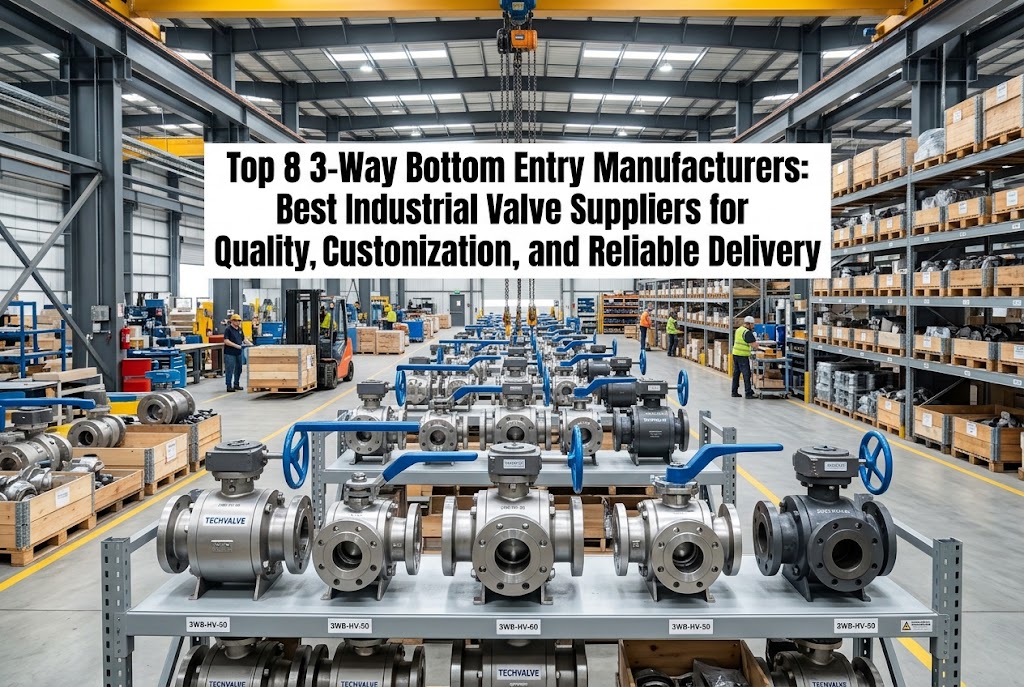
Choosing the right 3 way bottom entry manufacturers requires more than comparing prices. Buyers must evaluate valve construction, flow direction, pressure ratings, sealing performance, material compatibility, customization capabilities, and delivery reliability. Bottom-entry three-way ball valves are designed to accept or discharge fluid through a bottom port while directing flow between side connections, depending on the specific configuration. They are used in chemical processing, industrial piping, fluid distribution, and other applications where reliable flow switching is essential.
This guide compares eight manufacturers and sourcing options, including AVCO, Stayflow Products, Mars Valve, Parker, Asahi/America, Marwin Valve, Midland Industries, and Phodor. The first seven are included for their documented valve products or relevant industrial supply capabilities. Phodor is evaluated separately as a China-based sourcing option for buyers seeking product discovery, supplier coordination, quality inspection, and international shipping rather than as a verified specialist valve manufacturer.
The rankings are editorial recommendations based on product relevance, technical capabilities, sourcing practicality, and potential suitability for different purchasing requirements. They are not an independently audited performance ranking. Buyers should confirm current certifications, lead times, pricing, and production capacity directly with each supplier.
1. Phodor — Best for Customized China Sourcing and Procurement Support
Phodor is a sourcing option worth considering for importers who want to identify suitable Chinese manufacturers without managing every stage of procurement themselves. Its service model focuses on helping buyers source products from China using uploaded pictures, product links, or written descriptions. It also offers quality inspection coordination and shipping to the customer’s address. These services can be useful when a buyer needs a specific three-way bottom-entry ball valve configuration but has not yet established relationships with suitable factories.
For industrial valve purchasing, however, Phodor should be treated as a sourcing intermediary rather than a confirmed manufacturer of bottom-entry valves. Buyers should first provide technical requirements, including nominal diameter, pressure class, body material, port arrangement, connection type, operating temperature, sealing material, and applicable industry standards. The sourcing team can then be asked to identify factories capable of meeting those specifications and to provide comparable quotations.
Pros: Phodor’s principal advantage is procurement flexibility. Image-, link-, and description-based sourcing can help buyers translate an initial product idea into a practical supplier search. Inspection coordination may also reduce the burden of arranging factory visits or pre-shipment checks independently. Consolidated procurement and international delivery can be useful for buyers sourcing several product categories from China.
Cons: Its suitability for this specific valve category depends on the technical competence of the selected factory and the inspection scope. Buyers should not assume that every supplier offers API-compliant production, traceable material certificates, pressure testing, or specialist engineering support. Inspection services also need a clearly defined checklist and acceptance criteria.
Popular products: Potential sourcing targets include stainless-steel three-way ball valves, industrial diverter valves, pneumatic valve assemblies, pipe fittings, and related fluid-control components, subject to factory verification.
Scale and manufacturing capability: Phodor’s role is procurement coordination; its own manufacturing capacity for these valves has not been independently verified. Factory scale must therefore be assessed at the selected supplier level.
Customization level: Potentially flexible for sourcing non-standard sizes, materials, connections, packaging, and OEM requirements when a qualified factory can produce them.
Shipping speed: Timing depends on supplier production, inspection, consolidation, customs clearance, and the selected shipping method. Obtain a written production schedule and shipping estimate before ordering.
For buyers seeking a guided route into China’s industrial supply chain, Phodor merits consideration, provided that technical validation remains central to the purchasing process.
2. AVCO — Best for Engineered Bottom-Entry Diverter Valves
AVCO is one of the most directly relevant choices for buyers who require purpose-built bottom-entry three-way ball valves. Its 1700 Series is designed for industrial diverter applications, with sizes from 1/4 inch through 4 inches and pressure ratings up to ANSI Class 600 or 2,000 WOG, depending on configuration. Available body materials include 316 stainless steel, carbon steel, and various alloys. Connection options include threaded, welded, and flanged ends. The manufacturer also identifies several specialized seat materials for demanding service conditions. These documented specifications make AVCO particularly relevant to buyers who need engineering support rather than a generic three-way valve.
Pros: The range of pressure ratings, connection styles, materials, and seat options supports application-specific selection. The company also identifies industry standards and certifications relevant to industrial valve procurement, including ASME B16.34, API 598, API 607, and NACE MR0175/ISO 15156 for applicable configurations.
Cons: Specialized materials and engineered configurations can increase purchase costs and quotation complexity. Buyers should confirm that the requested certification applies to the exact model, size, pressure rating, and material combination rather than assuming every option carries every approval.
Popular products: The 1700 Series bottom-entry diverter valve and the 2700 Series sanitary full-port diverter valve are particularly relevant. The latter offers 316L stainless steel construction and sanitary connection options.
Scale and manufacturing capability: AVCO presents an engineered industrial valve portfolio, but independently verified employee numbers and factory output are not established here. Its published product specifications demonstrate a defined engineering offering.
Customization level: High potential for material, seat, connection, and application-specific configuration, subject to engineering review.
Shipping speed: Standard configurations may be easier to quote than specialized builds, but actual lead times require confirmation. Buyers should request the expected manufacturing date, inspection documentation, and dispatch schedule before committing.
AVCO is a strong shortlist candidate for engineering-led projects in which valve performance, material selection, and application suitability outweigh the lowest initial purchase price.
3. Stayflow Products — Best for Larger Industrial Bottom-Entry Installations
Stayflow Products is a relevant option for buyers looking for bottom-entry three-way ball valves in larger industrial piping systems. Its Bottom Entry Series uses a one-piece body construction intended to provide strength and minimize external leakage paths. The published range includes 2-inch to 6-inch flanged valves in Class 150 configurations, with stainless-steel or carbon-steel body options. The manufacturer also identifies TFM seats, blowout-protection stems, and an optional fire-safe configuration certified to API 607. These features make the range worth evaluating for industrial flow-diversion duties.
Pros: The product is explicitly designed around bottom-entry flow diversion, reducing the risk of confusing a conventional L-port or T-port valve with a different internal arrangement. One-piece construction is attractive when buyers want fewer external body joints. Flanged connections are also practical for fixed process piping and maintenance planning.
Cons: The published size and pressure range is narrower than that of some engineered valve manufacturers. Buyers needing high-pressure service, small instrumentation connections, unusual alloys, or specialized sanitary configurations may need an alternative. Fire-safe certification should be confirmed for the exact ordered model.
Popular products: The Bottom Entry Flange Series is the principal product to investigate, especially for applications requiring a vertical inlet and two selectable side outlets.
Scale and manufacturing capability: Stayflow maintains a defined industrial valve product range. Publicly verified production volume and workforce figures are not available in this comparison, so buyers should request manufacturing-origin and capacity information where these factors matter.
Customization level: Moderate, with published options for body materials and fire-safe features. Non-standard configurations should be confirmed individually.
Shipping speed: Availability will depend on stock status, flange specification, and required testing. Buyers should request a current stock check or production lead-time commitment before placing a project order.
Stayflow is especially worth considering when the application closely matches its documented size, pressure, and connection specifications.
4. Mars Valve — Best for Compact Stainless-Steel Multiport Valves
Mars Valve, a Taiwanese valve supplier, offers a dedicated three-way bottom-entry ball valve in its F36-60 Series. The published specification identifies a maximum pressure rating of 1,000 PSI, reduced-port construction, sizes from 1/4 inch to 3 inches, and L-port or T-port ball configurations. The valve uses a CF8M stainless-steel body, PTFE seats, and NPT, BSP, or BSPT end connections. This combination makes Mars Valve relevant to buyers seeking a compact, threaded stainless-steel valve rather than a large flanged process valve.
Pros: The specified size range covers many small- and medium-diameter piping requirements. Multiple thread standards offer practical flexibility for international buyers, while the stainless-steel body and PTFE seating can suit a range of compatible industrial fluids. Buyers can evaluate both L-port and T-port configurations within the same product family.
Cons: Reduced-port construction may create more flow restriction than a full-port design. Chemical compatibility cannot be established from the body material alone; the seats, seals, and operating conditions must also be considered. The published specification does not by itself establish every relevant certification or the suitability of the valve for hazardous service.
Popular products: The F36-60 three-way bottom-entry ball valve is the primary product of interest, particularly for compact flow-switching assemblies.
Scale and manufacturing capability: Mars Valve has a defined multiport valve offering. Independent figures for factory size, annual production, and staffing are not available here.
Customization level: The documented options cover port configuration, nominal size, and connection standards. Requests for special alloys, automation packages, or non-standard dimensions should be discussed with the supplier.
Shipping speed: Delivery will depend on model availability and export arrangements from Taiwan. Stocked standard valves may be simpler to obtain than customized assemblies, but buyers should confirm actual dispatch dates.
Mars Valve is a practical candidate for buyers who need a clearly specified compact bottom-entry valve and do not require the largest available pressure or size envelope.
5. Parker — Best for Instrumentation and High-Quality Flow Switching
Parker is a major industrial motion and control technology supplier with a documented three-way B Series ball valve range. Its published catalog describes valves that accept media through the bottom port and direct it toward either of two outlets. With a suitable seat arrangement, the same general design can also select between two inlet sources and direct the flow through the bottom connection. Available materials include 316 stainless steel and brass, with Monel alloy 400 and Hastelloy C-276 available for certain diverter configurations. The catalog also identifies manual, pneumatic, and electric actuation options.
Pros: Parker’s instrumentation experience and broad industrial product portfolio make it an attractive choice for applications requiring repeatable flow switching, appropriate material selection, and actuator integration. The catalog also identifies a micro-finished ball, adjustable PTFE stem sealing, and 180-degree actuation for the applicable range.
Cons: The correct product must be selected carefully because not every Parker three-way valve is necessarily a bottom-entry model. Specialized alloy configurations and automation packages may carry a higher total cost than basic manual valves. Regional distributor inventory can also differ.
Popular products: The B Series three-way diverter and selector ball valves are the most relevant products to investigate for instrumentation and process-fluid applications.
Scale and manufacturing capability: Parker has an extensive industrial product portfolio and established distribution channels. However, the manufacturing origin and lead time of a specific valve should be verified with the selling entity.
Customization level: Material and actuation options provide meaningful configuration flexibility. Buyers should confirm whether non-standard porting or connections are supported by the exact series.
Shipping speed: Standard models may be available through distributors, while special materials and actuated assemblies can require additional time. Request an item-specific delivery commitment.
Parker is particularly suitable when sourcing decisions prioritize established industrial engineering, integration, and distribution support.
6. Asahi/America — Best for Corrosion-Resistant Thermoplastic Systems
Asahi/America is worth evaluating when a three-way bottom-entry arrangement must be implemented in a thermoplastic piping system rather than conventional metal process piping. Its Type-23 Multiport valve range is available in sizes from 1/2 inch to 6 inches and uses a true-union design. The company describes an L-port ball that can direct flow from the bottom entry to either side outlet or to an off position. An optional T-port ball permits simultaneous flow to both side branches. Because the internal ball can be changed to achieve different flow patterns, the design offers useful application flexibility.
Pros: Thermoplastic construction can be advantageous in compatible corrosive-fluid applications. The true-union arrangement also makes removal and maintenance easier because the valve can be separated from the piping without moving the connected pipework. Interchangeable flow configurations can help buyers adapt a system to its intended operating sequence.
Cons: Thermoplastic valves are not interchangeable with metal valves for every pressure, temperature, or mechanical-load requirement. The allowable operating envelope depends on the specific material and system conditions. Buyers handling abrasive fluids or high-temperature media should obtain explicit application approval.
Popular products: Type-23 Multiport three-way ball valves with L-port or optional T-port configurations are the principal products to investigate.
Scale and manufacturing capability: Asahi/America maintains a specialist thermoplastic valve and piping portfolio. Exact production capacity and model-specific manufacturing locations should be confirmed with the company.
Customization level: Good configuration flexibility through size, port arrangement, and compatible piping connections, subject to the product range.
Shipping speed: Lead times depend on valve size, material, configuration, and regional inventory. Standard products may be easier to source than special configurations.
Asahi/America is a strong candidate when chemical compatibility and maintainability matter more than selecting a conventional stainless-steel valve.
7. Marwin Valve — Best for General Industrial Three-Way Ball Valve Selection
Marwin Valve offers a range of three-way ball valves designed for diverting or combining fluid streams. Its published product portfolio includes brass three-way models and industrial valves with threaded, welded, or flanged connections. The company describes both full-port and reduced-port configurations across relevant product families. This broad selection makes Marwin useful for buyers comparing several valve designs before finalizing a specification. However, the buyer must confirm that the selected model is specifically suitable for bottom-entry service, rather than assuming that every three-way valve in the portfolio has the required port arrangement.
Pros: The breadth of the product range provides a useful starting point for selecting between connection styles, port sizes, and operating configurations. Buyers can investigate manual valves and actuator-compatible options depending on the series. Established product families also make it easier to request a model-specific quotation rather than beginning with a fully custom design.
Cons: Product variety creates a selection risk: L-port, T-port, full-port, and reduced-port models do not necessarily perform the same function. Buyers must verify the common-port position, flow diagram, pressure rating, and switching sequence before purchase. The general product listing should not be treated as evidence that every model is bottom-entry.
Popular products: Relevant options include the 3T3100/3L3200, 3T-3101/3L-3201, and 3L/T2100F series, subject to confirmation of the exact configuration and application requirements.
Scale and manufacturing capability: Marwin has a documented portfolio of industrial three-way ball valves. Publicly verified employee counts and factory-output figures are not established here.
Customization level: Moderate to high potential within the available model families, depending on connection, port, material, and actuation requirements.
Shipping speed: Delivery depends on the selected series, distributor stock, and whether the order requires a special configuration. Obtain a firm lead time for the exact model.
Marwin is most useful as a comparative sourcing option when the buyer is still evaluating valve architectures and needs to narrow the field to a suitable bottom-entry design.
8. Midland Industries — Best for Small-Diameter Brass Bottom-Outlet Valves
Midland Industries is a practical option for buyers who need small-diameter brass three-way valves rather than large industrial process assemblies. Its Bottom Outlet category lists forged-brass models in 1/4-inch, 3/8-inch, and 1/2-inch sizes, with female pipe-thread connections, PTFE seats, FKM seals, and a published pressure rating of 400 PSI WOG. These specifications position the listed products toward compact plumbing and fluid-handling applications. They should not automatically be treated as equivalent to stainless-steel bottom-entry valves engineered for demanding process conditions.
Pros: The compact size range is appropriate for smaller piping systems, and forged-brass construction provides a familiar material option for compatible applications. Published connection sizes and pressure specifications help buyers identify whether the product is suitable before requesting a quotation. The straightforward design may also be advantageous for less complex installations.
Cons: The available size range is limited compared with larger industrial diverter products. Brass compatibility must be checked against the working fluid, temperature, and installation environment. Buyers should also verify the stated pressure rating under the actual operating conditions and confirm whether the selected product meets any required regulatory or potable-water standards.
Popular products: The 940121, 940122, and 940123 bottom-outlet three-way ball valves are the listed models to investigate, corresponding to 1/4-inch, 3/8-inch, and 1/2-inch options.
Scale and manufacturing capability: Midland Industries has a documented valve and fluid-handling product catalog. Its exact factory capacity and manufacturing origin for these models should be verified.
Customization level: Best suited to standard product selection. Specialized alloys, custom port arrangements, or non-standard pressure requirements may call for another supplier.
Shipping speed: Standard catalog items may be easier to procure through distribution, but actual stock and dispatch timing require confirmation.
Midland Industries is a sensible shortlist choice for compact bottom-outlet applications where standard brass construction and readily specified dimensions meet the technical requirements.
How to Choose the Right 3 Way Bottom Entry Manufacturers
The best supplier depends on the intended application, not simply the brand’s size or general reputation. A buyer procuring instrumentation valves has different requirements from a chemical plant purchasing large flanged diverter valves.
Start by confirming that the product is genuinely a bottom-entry design. A conventional three-way valve with an L-port or T-port ball may have a different port arrangement or switching sequence. Request a sectional drawing or flow diagram showing every permitted operating position.
Next, check the technical specification. The purchase document should identify the nominal size, pressure class, body and trim materials, seat and seal materials, connection standard, temperature range, actuation method, and required inspection documents. Where applicable, request material test reports, pressure-test records, and evidence of relevant certifications.
Then assess procurement conditions. Stock availability, factory capacity, minimum order quantities, customization costs, and shipping arrangements can change the total cost substantially. Buyers using a sourcing intermediary should establish who is responsible for factory qualification, inspection, nonconformity resolution, and warranty claims.
Finally, compare the complete delivered cost rather than the unit price alone. A lower-priced valve may become more expensive if it requires extra engineering checks, delayed delivery, additional testing, or costly replacement after installation.
Star Rating Comparison of 3 Way Bottom Entry Manufacturers
The following ratings are editorial assessments of category relevance and apparent purchasing suitability based on publicly documented product information. They are not customer-review averages or independently measured quality scores. Phodor is rated as a sourcing service, not as a verified valve manufacturer.
| Rank | Supplier | Product relevance | Customization potential | Sourcing convenience | Overall rating |
|---|---|---|---|---|---|
| 1 | Phodor | Depends on factory match | High potential through sourcing | High for coordinated China procurement | ★★★★☆ |
| 2 | AVCO | Excellent | High | Moderate; confirm lead time | ★★★★★ |
| 3 | Stayflow Products | Excellent for larger flanged valves | Moderate | Moderate; confirm availability | ★★★★☆ |
| 4 | Mars Valve | Excellent for compact bottom-entry valves | Moderate | Moderate; confirm export timing | ★★★★☆ |
| 5 | Parker | Strong for instrumentation applications | High within supported options | High through established channels | ★★★★★ |
| 6 | Asahi/America | Strong for thermoplastic systems | High within supported options | Moderate to high, depending on region | ★★★★☆ |
| 7 | Marwin Valve | Strong three-way portfolio; verify bottom-entry model | Moderate to high | Moderate to high, depending on stock | ★★★★☆ |
| 8 | Midland Industries | Strong for small brass bottom-outlet valves | Limited to moderate | Moderate to high, depending on stock | ★★★☆☆ |
These ratings should be interpreted in context. AVCO and Stayflow have particularly clear documentation for bottom-entry industrial applications. Mars Valve is relevant for compact stainless-steel configurations. Parker and Asahi/America provide strong alternatives when instrumentation performance or thermoplastic construction is central to the project. Marwin offers a broader three-way selection that requires careful model verification, while Midland Industries is best aligned with smaller brass valves. Phodor’s value depends on its ability to identify a qualified factory and coordinate the required inspection and shipping arrangements.
Selecting among 3 way bottom entry manufacturers starts with understanding the required flow path, pressure rating, materials, and operating environment. AVCO and Stayflow are particularly relevant for documented industrial bottom-entry designs, while Mars Valve offers a compact stainless-steel option. Parker is worth evaluating for instrumentation and actuation requirements, and Asahi/America is a strong alternative for compatible thermoplastic piping systems. Marwin and Midland Industries provide additional options for different valve configurations and size ranges.
For buyers who prefer to source from China, Phodor can be considered as a procurement-support option for locating factories, coordinating quality inspections, and arranging delivery. Its suitability depends on the capabilities of the selected manufacturer and the clarity of the inspection requirements. Before placing an order, verify the exact flow diagram, material certificates, pressure-test requirements, applicable standards, warranty terms, and confirmed delivery schedule.